
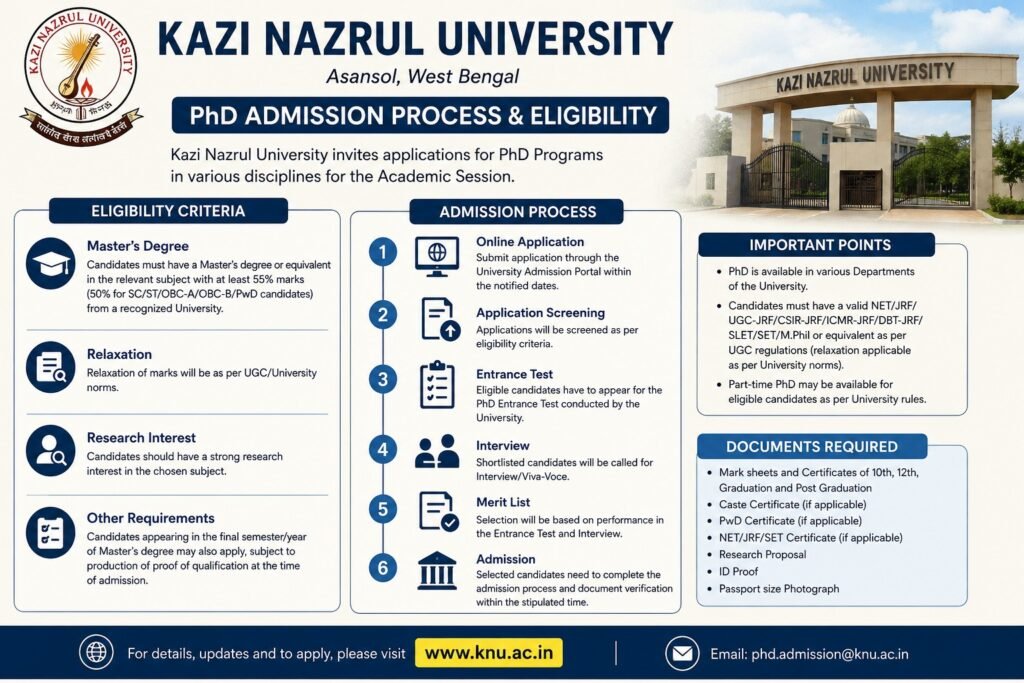

Pursuing a Doctor of Philosophy is one of the most significant academic decisions a student can make. It requires careful planning, a clear understanding of the admission process, and the right choice of university. Kazi Nazrul University, commonly known as KNU, has steadily grown into one of the respected state universities in West Bengal, offering a strong research environment across multiple disciplines. If you are considering a PhD from this university, this guide will walk you through everything you need to know, from eligibility criteria to the final selection process.
Whether you are a fresh postgraduate looking to begin your research journey or a working professional aiming to advance your academic qualifications, understanding the Kazi Nazrul University PhD admission process and eligibility in full detail will help you prepare better and avoid last-minute confusion.
Overview of Kazi Nazrul University
Kazi Nazrul University was established in 2012 by the Government of West Bengal. It is situated in Asansol, in the Paschim Bardhaman district, and is named after the legendary poet and national poet of Bangladesh, Kazi Nazrul Islam. The university offers undergraduate, postgraduate, and doctoral programmes across a range of disciplines including science, arts, commerce, and technology.
The university is recognised by the University Grants Commission (UGC) and maintains affiliations and academic standards consistent with national research guidelines. Over the years, KNU has been expanding its research facilities and encouraging students from across West Bengal and beyond to pursue quality doctoral education within a supportive academic setting.
Why Pursue a PhD from Kazi Nazrul University?
There are several good reasons why students choose KNU for their doctoral studies. The university offers a relatively affordable fee structure compared to central or private universities, making it accessible for students from diverse financial backgrounds. The faculty members across departments are actively engaged in research, which creates a productive environment for PhD scholars.
Being a state university in West Bengal, KNU follows UGC regulations strictly, which means a PhD degree from here holds value across India for academic and research positions. Students also benefit from access to libraries, laboratories, and academic collaborations that support serious research work. For those planning to build a career in teaching at the college or university level, a PhD from KNU is a recognised and credible qualification.
PhD Courses and Research Areas Offered
Kazi Nazrul University offers PhD programmes across various departments. Some of the key disciplines where research supervision is available include:
- Bengali Language and Literature
- English
- History
- Political Science
- Economics
- Education
- Physics
- Chemistry
- Mathematics
- Computer Science and Engineering
- Commerce and Management
- Environmental Science
- Music and Fine Arts
The availability of supervisors in a specific area may vary each year depending on faculty positions and existing scholar intake. Before applying, students are advised to check the official KNU website or contact the respective department directly to confirm supervisor availability in their chosen research area.
Don’t Miss: B Borooah College Admission Notice 2026
Eligibility Criteria for KNU PhD Admission
Before you begin the application process, it is important to confirm that you meet the eligibility requirements set by the university. The KNU PhD eligibility criteria generally follow UGC guidelines and are consistent with what most state universities in West Bengal follow.
Educational Qualifications Required
Candidates must have completed a Master’s degree or an equivalent postgraduate qualification from a recognised university. The degree must be in a subject relevant to the proposed area of research. In most cases, the candidate must hold a degree in the same or a closely related discipline as the department they are applying to.
For programmes that offer interdisciplinary research, candidates with postgraduate degrees from adjacent fields may also be considered, subject to the approval of the Research Committee and the concerned supervisor.
Minimum Marks Criteria
The minimum academic requirement for Kazi Nazrul University PhD admission is as follows:
- General category candidates must have secured at least 55 per cent marks or an equivalent grade in their postgraduate degree.
- Candidates belonging to SC, ST, OBC, PwD (Persons with Disability), and other reserved categories are typically eligible with a minimum of 50 per cent marks in their postgraduate qualification.
- Candidates who have completed an MPhil degree may also be eligible, provided they meet the minimum marks requirement at the postgraduate level.
It is worth noting that marks obtained in the final year or semester of the postgraduate programme are generally considered for eligibility. Students who are in their final year of the Master’s programme may also be permitted to apply provisionally, subject to meeting the criteria upon declaration of their results.
Entrance Test Details
The KNU entrance test for PhD admission is a written examination conducted by the university to assess the research aptitude and subject knowledge of the applicants. This test is usually referred to as the Research Entrance Test or RET.
The entrance test typically consists of two parts:
- Part A: This section tests general research aptitude, reasoning ability, and awareness of research methodology. It is broadly similar to the research aptitude section of UGC NET examinations.
- Part B: This section is subject-specific and tests the candidate’s knowledge of their chosen discipline at the postgraduate level.
The question paper is generally objective or multiple choice in nature, and the duration of the test is usually two hours. Candidates are required to appear at the designated examination centre on the specified date mentioned in the admission notification.
Exemption from Entrance Test
Not all candidates are required to appear for the university’s entrance examination. Certain categories of candidates are granted exemption from the RET based on their existing qualifications. These exemptions are in line with UGC norms and generally include:
- Candidates who have qualified UGC NET with JRF (Junior Research Fellowship)
- Candidates who have qualified UGC NET (without JRF but with lectureship eligibility)
- Candidates who have qualified CSIR NET with JRF or lectureship eligibility
- Candidates who have cleared SET or SLET examinations
- Candidates who have qualified GATE with a valid score
- Candidates who have already completed an MPhil degree from a recognised university
- Teacher Fellows appointed under recognised schemes
Even if a candidate is exempt from the written entrance test, they are generally still required to appear for the interview or viva voce round. Exemption only applies to the written component of the selection process.
Step by Step PhD Admission Process at KNU
The Kazi Nazrul University PhD application process broadly follows these stages:
- Official Notification: The university releases an official admission notification, usually available on the KNU website. This notification contains details about the number of seats available, disciplines offered, dates for application, entrance test schedule, and other important instructions.
- Online Registration: Interested candidates must register on the university’s official portal and fill in the online application form carefully.
- Document Upload: Scanned copies of required documents must be uploaded during the application process.
- Fee Payment: The application fee must be paid online through the designated payment gateway.
- Admit Card Download: Eligible candidates receive their admit cards for the entrance test through the portal.
- Entrance Test: Candidates appear for the written RET on the scheduled date, unless they are in an exempt category.
- Interview or Viva Voce: Shortlisted candidates are called for a personal interview before the Research Committee.
- Final Selection and Enrolment: Selected candidates receive provisional admission and complete enrolment formalities including fee payment and document verification.
Online Application Process
The application for PhD admission at Kazi Nazrul University is conducted online through the official university website. Candidates must visit the admissions section, locate the PhD admission notification for the relevant academic year, and follow the registration link. It is important to use a valid email address and mobile number during registration as all future communications, including admit cards and result updates, are sent to these contact details.
Students are advised to read the prospectus or information brochure carefully before filling out the form. Any incorrect information submitted may lead to cancellation of the application at a later stage.
Documents Required for Application
The following documents are generally required during the application process for PhD admission in West Bengal at Kazi Nazrul University:
- Recent passport-sized photograph
- Scanned signature
- Class 10 marksheet and certificate (for date of birth proof)
- Class 12 marksheet and certificate
- Bachelor’s degree marksheets and certificate
- Master’s degree marksheets and certificate
- NET, SET, GATE, or MPhil certificate if claiming exemption
- Caste or category certificate for reserved category candidates
- PwD certificate if applicable
- Experience certificate if applicable
- Research proposal (if required by the department)
Documents should be scanned clearly and kept in the required file format and size as specified in the application instructions. Uploading blurred or incomplete documents can result in rejection of the application.
Application Fees
The application fee for KNU PhD admission varies by category. Generally, the fee structure is as follows:
| Category | Application Fee (Approximate) |
| General / OBC | Rs. 500 to Rs. 700 |
| SC / ST / PwD | Rs. 250 to Rs. 350 |
Please note that these figures are indicative and may change each year. Always refer to the official admission notification for the exact fee amount applicable in the year you are applying.
Selection Procedure and Interview Process
After the entrance test, the university prepares a merit list based on the candidates’ performance. Those who clear the written test are called for an interview conducted by the Research Committee of the respective department.
The interview or viva voce is an important part of the selection process. During the interview, candidates may be asked about their research interest, proposed topic, academic background, and their reasons for choosing a particular area of study. Candidates who are in the exempt category (such as NET or GATE qualified) are directly called for the interview round based on their qualifying scores.
The final merit list is prepared by combining the written test score and the interview performance. In some departments, candidates may also be required to submit a brief research proposal before the interview, which is then discussed during the viva session.
Important Dates and Admission Timeline
The exact dates for KNU PhD admission vary each academic year. The admission cycle generally follows this timeline, though official dates must always be confirmed from the university’s notification:
| Activity | Approximate Period |
| Release of Official Notification | February to April |
| Online Application Period | March to May |
| Admit Card Release | Two to Three Weeks Before Exam |
| Entrance Examination (RET) | May to June |
| Interview / Viva Voce | June to July |
| Final Merit List and Admission | July to August |
Students are strongly advised to regularly check the official KNU website and keep track of notifications, as dates are subject to change depending on academic schedules and other factors.
Fee Structure Overview for PhD Programme
The semester-wise or annual fee for the PhD programme at Kazi Nazrul University is relatively modest compared to private universities. The fee generally covers registration charges, course work fee, examination fee, and library or laboratory charges depending on the discipline. Exact fee details are published in the admission brochure each year.
Scholars who receive fellowships or assistantships from external bodies such as UGC, CSIR, DBT, or DST may use their fellowship amount to cover a significant portion of these fees.
Scholarship Opportunities for PhD Scholars
Funding is a major concern for most PhD aspirants, and there are several scholarship options worth knowing about:
- UGC Junior Research Fellowship: For candidates who have qualified UGC NET JRF, this fellowship provides a monthly stipend along with a contingency grant for research expenses.
- CSIR Fellowship: Available to science stream candidates who qualify the CSIR NET JRF examination.
- DST INSPIRE Fellowship: Offered by the Department of Science and Technology for science students.
- West Bengal State Fellowships: The West Bengal government occasionally offers state-funded fellowships for research scholars enrolled in recognised state universities including KNU.
- Institutional Assistantship: Some departments at KNU may have provisions for teaching assistantship where scholars assist in undergraduate or postgraduate teaching in exchange for a modest stipend.
Students are encouraged to apply for fellowships simultaneously with their PhD admission process to avoid financial interruptions during the research period.
Tips for Students Preparing for KNU PhD Admission
Preparing for PhD admission requires a combination of academic readiness and practical planning. Here are some helpful tips to guide you through the process:
- Start preparing for the entrance test well in advance. Revise your postgraduate syllabus thoroughly and also practise research aptitude questions similar to UGC NET Paper 1.
- Identify a potential research topic early and read widely in that area. This will help you during the interview when you are asked about your research interest and objectives.
- Look for potential supervisors in your department before applying. Read their published research work to understand their areas of expertise and align your proposal accordingly.
- Keep all your academic documents properly organised and ready in digital format for uploading during the application process.
- Keep checking the official KNU website regularly, especially during the months when the notification is expected.
- Do not rely solely on secondhand information. Always verify admission requirements from official sources.
Guidance for Parents Supporting Their Children
Many parents are not fully familiar with what a PhD involves and how to support their child through this journey. Here are a few points that may help:
A PhD is a long-term academic commitment that typically spans three to five years. It involves independent research under the guidance of a supervisor, coursework in the initial phase, and eventually the submission and defence of a thesis. Your role as a parent is to provide emotional support and encourage patience, as research is not always a straightforward path.
Encourage your child to apply for fellowships from the very beginning so that they are not financially dependent on family support throughout the programme. Also help them keep track of deadlines and document requirements, as missing these can set the application back by an entire year.
If your child is unsure about a research topic, suggest speaking to faculty members or former PhD scholars who can offer practical guidance. Choosing the right topic and the right supervisor is as important as the university itself.
Conclusion
Kazi Nazrul University offers a credible and affordable pathway for students aspiring to pursue doctoral research in West Bengal. With its growing range of research disciplines, qualified faculty, and alignment with UGC regulations, KNU is a practical choice for students who are serious about academic and research careers.
Understanding the complete Kazi Nazrul University PhD admission process and eligibility in advance gives you a clear advantage. Whether you are preparing for the entrance test, gathering documents, or planning your research proposal, being well-informed at every stage reduces uncertainty and increases your chances of a smooth admission experience.
Always refer to the official KNU website for the latest and most accurate information, as admission details are updated each year. With the right preparation and timely action, your PhD journey at Kazi Nazrul University can be a truly rewarding academic experience.
Frequently Asked Questions
What is the minimum educational qualification required for KNU PhD admission?
Candidates must hold a Master’s degree or an equivalent postgraduate qualification from a recognised university in the relevant subject. General category candidates need a minimum of 55 per cent marks, while SC, ST, OBC, and PwD candidates are eligible with a minimum of 50 per cent marks at the postgraduate level.
Is there an entrance test for Kazi Nazrul University PhD admission?
Yes, KNU conducts a Research Entrance Test (RET) for PhD admission. However, candidates who have qualified UGC NET, CSIR NET, SET, GATE, or who hold an MPhil degree from a recognised university are generally exempt from the written entrance test. All candidates, including those in exempt categories, are typically required to appear for an interview.
How can I apply for the KNU PhD programme?
The application process is conducted online through the official Kazi Nazrul University website. Candidates need to register on the admissions portal, fill in the application form, upload the required documents, and pay the application fee online. Admit cards and other updates are communicated through the registered email and mobile number.
Are there any scholarship options available for PhD scholars at KNU?
Yes, PhD scholars at KNU can avail of various scholarships and fellowships. These include UGC JRF for NET qualified candidates, CSIR fellowship for science students, DST INSPIRE fellowship, and state-level fellowships offered by the West Bengal government. Candidates are advised to apply for these fellowships alongside their PhD admission to secure financial support for their research.
What is the duration of the PhD programme at Kazi Nazrul University?
As per UGC regulations, the minimum duration for a PhD programme is three years from the date of registration, including the mandatory coursework period. The maximum duration is generally five to six years, with provisions for extension in exceptional cases. The exact timeline may vary depending on the nature of the research and departmental guidelines.
Published By branding.net.in