

The Quiet Revolution in How Indian Businesses Present Themselves
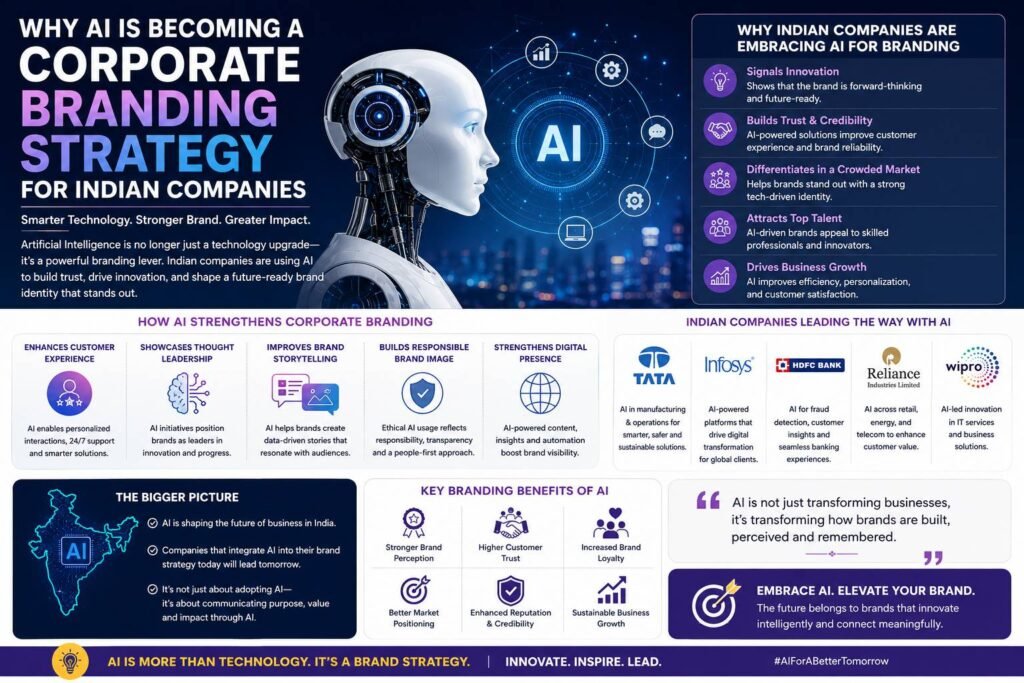
Something significant is happening in boardrooms across Mumbai, Bengaluru, Hyderabad, and Delhi. Indian companies — from legacy conglomerates to nimble startups — are no longer treating artificial intelligence purely as an operational tool. They are weaving it into the very fabric of how they present themselves to the world. Understanding why AI is becoming a corporate branding strategy for Indian companies requires looking at a convergence of market forces, consumer expectations, and global competitive pressures that are reshaping the business landscape.
This is not about slapping an “AI-powered” badge on a product. It is a deeper, more deliberate positioning exercise that signals innovation, trustworthiness, and future-readiness to investors, customers, and talent alike.
The Credibility Signal That AI Now Carries
For decades, Indian companies have battled perception challenges in global markets — stereotypes around cost-cutting rather than innovation, service delivery rather than product leadership. AI adoption and, more importantly, AI-led branding is helping dismantle those narratives.
When Infosys launched its Topaz AI platform or when Wipro introduced ai360, these were not merely product announcements. They were brand statements. They told the market: we are not just executing your digital transformation, we are leading it. The same logic applies to mid-sized Indian enterprises that are now prominently featuring AI capabilities in their investor presentations, annual reports, and marketing campaigns.
Credibility in the modern business environment is increasingly tied to technological sophistication. AI has become a shorthand for that sophistication, and Indian companies are acutely aware of this dynamic.
Consumer Expectations Are Driving the Shift
Indian consumers — particularly urban millennials and Gen Z — have grown accustomed to AI-driven experiences through global platforms like Netflix, Spotify, and Google. When they interact with domestic brands, they bring those expectations with them. Companies that can demonstrate intelligent personalization, predictive service, and seamless automation are not just winning customers; they are winning loyalty and word-of-mouth advocacy.
Banks like HDFC and ICICI have prominently marketed their AI-driven customer service capabilities, virtual assistants, and fraud detection systems. Insurance companies are highlighting AI-powered claim processing. E-commerce platforms are showcasing recommendation engines. In each case, the AI feature is not buried in a technical specification sheet — it is front and centre in consumer-facing communication because it resonates.
This consumer pull is a significant reason why AI is becoming a corporate branding strategy for Indian companies rather than remaining a back-office efficiency measure.
The Talent War and Employer Branding
India produces approximately 1.5 million engineering graduates annually, and a growing proportion of the most talented among them are prioritising employers who work with cutting-edge technology. AI-led branding is, therefore, also an employer branding strategy.
Companies that position themselves as AI-first or AI-native attract better engineering talent, data scientists, and product managers. This creates a virtuous cycle: better talent builds better AI capabilities, which strengthens the brand further. Startups like Sarvam AI and Krutrim have built their entire brand identities around AI, attracting significant attention from both investors and potential employees.
Established companies understand this dynamic too. Tata Consultancy Services, for instance, has made AI and machine learning capabilities central to its talent narrative, using them as recruitment differentiators in a competitive market.
Investor Confidence and Valuation Premiums
Capital markets have been generous to companies that can credibly articulate an AI strategy. Globally, companies with strong AI narratives have commanded valuation premiums, and Indian markets are reflecting this trend. The BSE and NSE have seen technology-oriented companies with clear AI roadmaps attract stronger institutional interest.
For Indian startups seeking venture capital or preparing for public listings, AI positioning has become almost non-negotiable. Investors are asking pointed questions about AI strategy, and founders who can answer with specificity and vision are rewarded with better terms and higher valuations.
This financial incentive is a powerful accelerant. It explains why even companies in traditionally non-tech sectors — agriculture, logistics, healthcare, and manufacturing — are developing and prominently communicating AI initiatives. The branding benefit extends directly to the balance sheet.
Differentiation in a Crowded Market
India’s domestic market is intensely competitive across virtually every sector. In this environment, differentiation is existential. AI offers a differentiation narrative that is both aspirational and practical.
Consider the pharmaceutical sector, where companies like Dr. Reddy’s and Sun Pharma are highlighting AI applications in drug discovery and supply chain optimisation. Or the retail sector, where brands are using AI-driven inventory management and customer analytics as proof points of operational excellence. These are not trivial claims — they represent genuine capability — but the decision to make them public-facing is a branding choice.
The strategic logic is straightforward: in a market where price competition is fierce and product differentiation is difficult, being perceived as the smarter, more technologically advanced option is a meaningful advantage.
The National Context: India’s AI Ambition as Brand Fuel
The Indian government’s National AI Strategy and initiatives like IndiaAI Mission have created a favourable macro-narrative. When the government positions India as a global AI powerhouse, individual companies benefit from riding that wave. Corporate AI branding aligns with national ambition, which resonates with domestic audiences and creates goodwill.
This national context is somewhat unique to India and helps explain why AI is becoming a corporate branding strategy for Indian companies at a pace and intensity that may differ from other markets. There is a patriotic dimension to the narrative — building world-class AI capability from India, for India and the world — that companies are consciously leveraging.
Building Authentic AI Brands
The most important caveat in all of this is authenticity. Companies that use AI as a branding veneer without substantive capability behind it risk significant reputational damage as consumers and investors become more sophisticated. The brands that will win in the long run are those that combine genuine AI investment with transparent communication about what that investment delivers.
Indian companies are increasingly recognising this distinction. The most successful AI brand strategies are built on real use cases, measurable outcomes, and honest acknowledgement of where AI still has limitations. That combination of ambition and integrity is what will ultimately define the next generation of great Indian corporate brands.
READ MORE:
- Why Reliance Power Is Entering the AI Business and What It Means for Investors
- Branding Meaning: Definition, Importance, Types, and Examples (2026 Guide)
- How to Choose the Best Branding Agency for Your Business in India
Published By Branding.net.in