
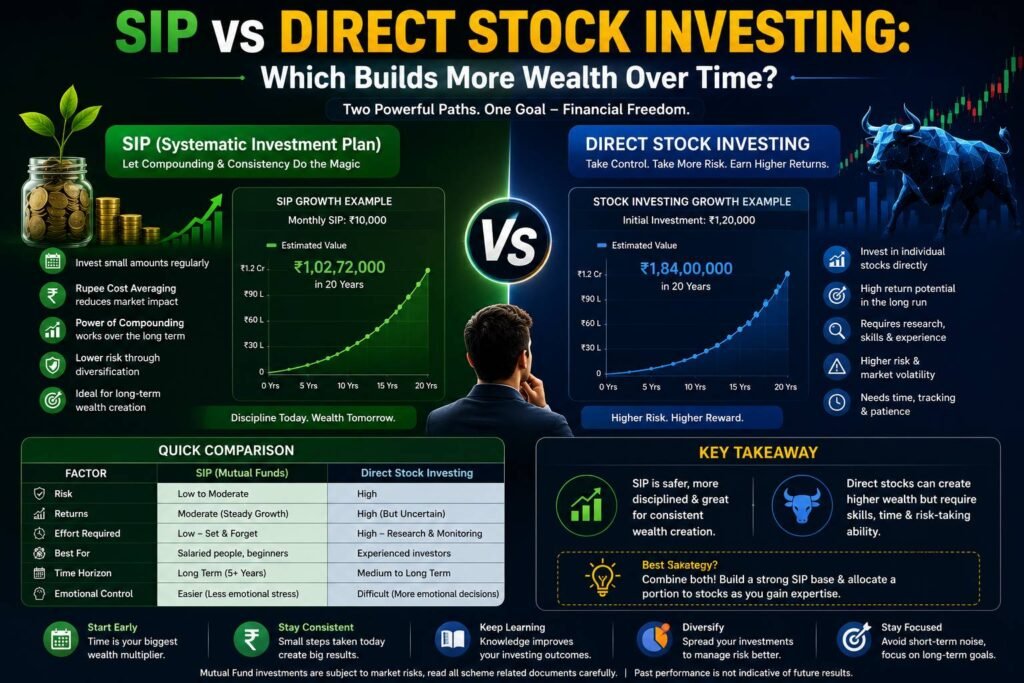

Two Paths to Wealth: Understanding the Core Difference
When it comes to growing your money in the financial markets, investors typically face a fundamental choice: the disciplined, automated route of a Systematic Investment Plan (SIP), or the hands-on, research-driven world of direct stock investing. Both approaches have produced genuine millionaires, and both have left underprepared investors with painful losses. The real question isn’t which method sounds better in theory — it’s which one is more likely to build lasting wealth given your skills, temperament, and time horizon.
Understanding the SIP vs direct stock investing debate requires an honest look at what each strategy actually demands of you, and what it realistically delivers over time.
What Is a SIP and How Does It Work?
A Systematic Investment Plan allows investors to contribute a fixed amount of money at regular intervals — usually monthly — into a mutual fund or index fund. The fund manager (or in the case of index funds, the index itself) handles the selection and weighting of underlying stocks.
The power of SIPs lies in three compounding forces working simultaneously:
- Rupee-cost averaging: You buy more units when prices are low and fewer when prices are high, naturally smoothing out market volatility over time.
- Compounding returns: Gains reinvested over years generate returns on previous returns, creating exponential growth.
- Behavioral discipline: Automation removes emotional decision-making, preventing the classic investor mistake of buying high and selling low.
A ₹10,000 monthly SIP in a diversified equity mutual fund delivering 12% annualized returns over 20 years would grow to approximately ₹99 lakh — without requiring the investor to pick a single stock.
What Is Direct Stock Investing?
Direct stock investing means purchasing shares of individual companies through a brokerage account. You decide which companies to buy, at what price, how much to allocate, and when to exit. Returns are entirely dependent on the quality of your research and the discipline of your execution.
The appeal is obvious: if you had invested directly in Infosys in 1993, or in Avenue Supermarts (DMart) at its IPO in 2017, your returns would have dwarfed any mutual fund benchmark by a significant margin. Direct stock investing offers the potential for outsized, market-beating gains that no diversified fund can match.
However, this upside comes with a demanding set of requirements:
- Deep knowledge of financial statements and business models
- Time to monitor portfolio companies regularly
- Emotional resilience during sharp drawdowns
- A clear framework for when to buy, hold, and sell
The Wealth-Building Comparison: Risk, Return, and Reality
Returns Potential
In the SIP vs direct stock investing comparison, direct investing wins on potential returns — but only for a minority of investors. Studies consistently show that roughly 80–90% of active retail investors underperform the broad market index over a 10-year period. This is not because the market is impossible to beat, but because consistently doing so requires skill, time, and emotional control that most investors underestimate.
SIPs in well-chosen equity mutual funds or index funds have historically delivered 10–14% annualized returns over long periods in India, which is sufficient to build substantial wealth through the power of compounding alone.
Risk Profile
Direct stock investing concentrates risk. A portfolio of 10–15 stocks can see individual holdings drop 50–80% during sector downturns or company-specific crises. Unless you have conviction backed by thorough research, concentration can devastate a portfolio.
SIPs spread risk across dozens or hundreds of companies, making catastrophic loss far less likely. The downside is that diversification also limits the ability to capture the extreme upside of a single breakout stock.
Time and Expertise Required
This is where many investors make their most honest decision. Direct stock investing is effectively a part-time (or full-time) job. Earnings calls, quarterly results, competitive analysis, management quality assessments — staying genuinely informed about even a 15-stock portfolio is a significant commitment.
SIPs, by contrast, can be set up in minutes and managed with a quarterly review. For working professionals, parents, or anyone without dedicated hours for market research, the SIP model is not a compromise — it is the strategically superior choice.
When Direct Stock Investing Makes Sense
Direct investing is not categorically inferior. For investors who have:
- Spent years studying specific industries or sectors
- Developed a repeatable research process
- Demonstrated the ability to hold through volatility without panic-selling
- A longer time horizon of 7–10 years minimum per holding
…direct stock investing can genuinely outperform. The key is honest self-assessment. Enthusiasm for the stock market is not the same as expertise in it.
Many experienced investors also use a hybrid approach — maintaining a core SIP portfolio for stability while allocating a smaller percentage (10–20%) to direct stock picks where they have high conviction.
The Behavioral Edge: Why SIPs Win for Most People
One of the most underappreciated factors in the SIP vs direct stock investing discussion is investor behavior. Research by DALBAR and others consistently shows that the average investor earns significantly less than the funds they invest in — because they buy and sell at the wrong times.
SIPs structurally protect against this. When markets fall 30%, a SIP investor simply continues their monthly contribution, automatically buying more units at lower prices. A direct stock investor, watching individual holdings collapse, faces enormous psychological pressure to exit.
Wealth is built not just by picking the right assets, but by staying invested long enough for compounding to work its magic. SIPs make this dramatically easier.
The Verdict
The debate between SIP vs direct stock investing ultimately comes down to a simple framework: how much edge do you genuinely have?
If you have deep industry knowledge, time for rigorous research, and proven emotional discipline, direct stock investing can build exceptional wealth. If you are an average investor — even an intelligent, financially literate one — a consistent SIP in diversified equity funds will almost certainly outperform your own stock-picking attempts over a 15–20 year horizon.
The best investment strategy is not the one with the highest theoretical ceiling. It is the one you will actually execute, maintain through downturns, and hold long enough to let compounding do its transformative work.
READ MORE:
- SIP vs Stock Market: Which Is Safer for First-Time Investors?
- ET Money SIP Calculator: How to Calculate Your Mutual Fund Returns in 2026
- Can Vidrush AI Transform Personal Branding?
Published By Branding.net.in