
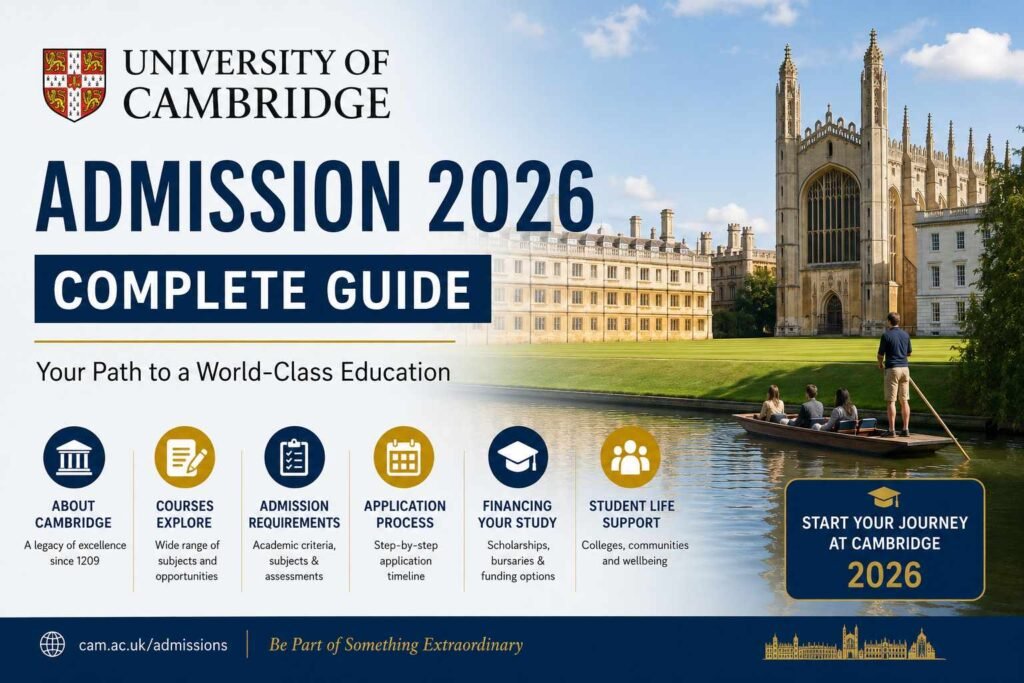

Overview of University of Cambridge Admission 2026
The University of Cambridge remains one of the most prestigious academic institutions in the world, attracting thousands of ambitious students from every corner of the globe each year. For those planning to apply for University of Cambridge Admission 2026, understanding the process in detail is essential. The application cycle is highly structured, with strict deadlines, rigorous academic expectations, and a selection process that goes far beyond grades alone.
Whether you are an undergraduate hopeful or a postgraduate candidate, this guide covers everything you need to know to navigate the admissions process with confidence.
Key Dates and Deadlines
Timing is everything when it comes to Cambridge admissions. For undergraduate applicants targeting the 2026 entry cycle, the UCAS application deadline falls on 15 October 2025. This is an earlier deadline than most UK universities, and missing it means waiting another full year.
Key dates to keep in mind include:
- August 2025 – Registration opens for the Cambridge Online Preliminary Application (COPA) or My Cambridge Application (for international students)
- 15 October 2025 – UCAS application deadline (including personal statement and reference)
- October–November 2025 – Subject-specific admissions assessments
- December 2025 – Interviews conducted (typically in person or online for overseas applicants)
- January 2026 – Decisions communicated to applicants
Staying organised and preparing well in advance is absolutely critical for anyone pursuing University of Cambridge Admission 2026.
Undergraduate Admissions: What You Need to Know
Academic Requirements
Cambridge sets exceptionally high academic standards. For A-level students, the typical offer ranges from **AAA to A*AA, depending on the course. For the International Baccalaureate, most courses require between 40 and 42 points**, with 776 or higher in Higher Level subjects.
International qualifications are also accepted, and Cambridge provides detailed guidance on equivalent requirements for students educated under different national systems, including SAT/ACT scores for American applicants, Indian CBSE and ISC boards, and various European matriculation certificates.
Choosing the Right College
One of the most distinctive aspects of the University of Cambridge Admission 2026 process is the collegiate system. Applicants must choose a college when submitting their application, though they also have the option of making an open application if they have no preference. Each college has its own character, facilities, and community, but all teach the same courses to the same academic standard.
Researching colleges is worthwhile. Consider factors such as:
- Location within the city
- Accommodation availability
- Subject-specific strengths or reputation
- Financial support and bursary schemes
- Size and community atmosphere
Personal Statement
The personal statement submitted through UCAS is a critical component of your application. Cambridge admissions tutors look for genuine intellectual curiosity, depth of engagement with your chosen subject, and evidence that you have explored the field beyond the school curriculum. Avoid listing achievements without context — instead, demonstrate how your experiences have shaped your academic thinking.
Admissions Assessments
Most Cambridge courses require applicants to sit a pre-interview or at-interview admissions test. These assessments are subject-specific and are designed to evaluate analytical thinking, problem-solving ability, and subject knowledge under timed conditions.
Common assessments include:
- TMUA (Test of Mathematics for University Admission) – for Mathematics and related courses
- ENGAA (Engineering Admissions Assessment) – for Engineering
- NSAA (Natural Sciences Admissions Assessment) – for Natural Sciences
- MLAT (Modern Languages Admissions Test) – for Modern and Medieval Languages
- LNAT (Law National Admissions Test) – for Law
- TSA (Thinking Skills Assessment) – for several humanities and social science courses
Registration for most assessments opens in August 2025, with tests taking place in October or November 2025. Thorough preparation using past papers and official resources is strongly recommended.
The Interview Process
Cambridge interviews are renowned for being intellectually challenging and unlike typical job or school interviews. They are not designed to test what you know, but rather how you think. Interviewers often present unfamiliar problems or texts and observe how candidates reason through them in real time.
Interviews typically last between 20 and 45 minutes and are conducted by academics from the college. Most applicants have two interviews. For University of Cambridge Admission 2026, interviews are expected to take place in December 2025, with some international candidates interviewed online.
To prepare effectively:
- Revisit your personal statement and be ready to discuss anything you mentioned
- Practice thinking aloud when solving problems
- Read widely around your subject, including academic journals and recent developments
- Engage in mock interviews if possible
Postgraduate Admissions
For postgraduate applicants, the University of Cambridge Admission 2026 process is managed directly through the Cambridge Applicant Portal. Deadlines vary by course and funding round, so checking individual department pages is essential.
Postgraduate applications are assessed on:
- Academic transcripts and degree classification
- Research proposal (for research degrees)
- References from academic supervisors or employers
- English language proficiency (IELTS Academic minimum 7.5 overall for most courses)
- Relevant professional or research experience
Many popular courses are highly competitive, and early application is strongly advised, particularly if you are seeking funding through Cambridge Trust scholarships or external bodies.
Financial Considerations and Scholarships
Cambridge offers a range of financial support options. UK undergraduate students can access standard student finance, and the Cambridge Bursary Scheme provides additional non-repayable grants to students from lower-income households.
International students should explore:
- Cambridge Trust Scholarships
- Gates Cambridge Scholarships (for non-UK students)
- Government-funded schemes in their home countries
- College-specific awards and hardship funds
Final Tips for Applicants
Securing a place through University of Cambridge Admission 2026 is a significant achievement that requires sustained effort, intellectual ambition, and careful preparation. Here are a few final recommendations:
- Start preparing for admissions tests at least three to four months in advance
- Engage deeply with your subject rather than focusing solely on grades
- Seek feedback on your personal statement from teachers and mentors
- Visit open days or virtual events to understand the Cambridge environment
- Apply with genuine passion — admissions tutors can always tell the difference
The process is demanding, but for those who are truly committed to academic excellence, Cambridge offers an unparalleled educational experience.
READ MORE:
- Subharti University Admission 2026: Complete Guide
- Ganpat University Admission 2026: Complete Guide
- Farook College Admission 2026: Complete Guide
- FLAME University Admission 2026: Complete Guide
Published by Branding.net.in