
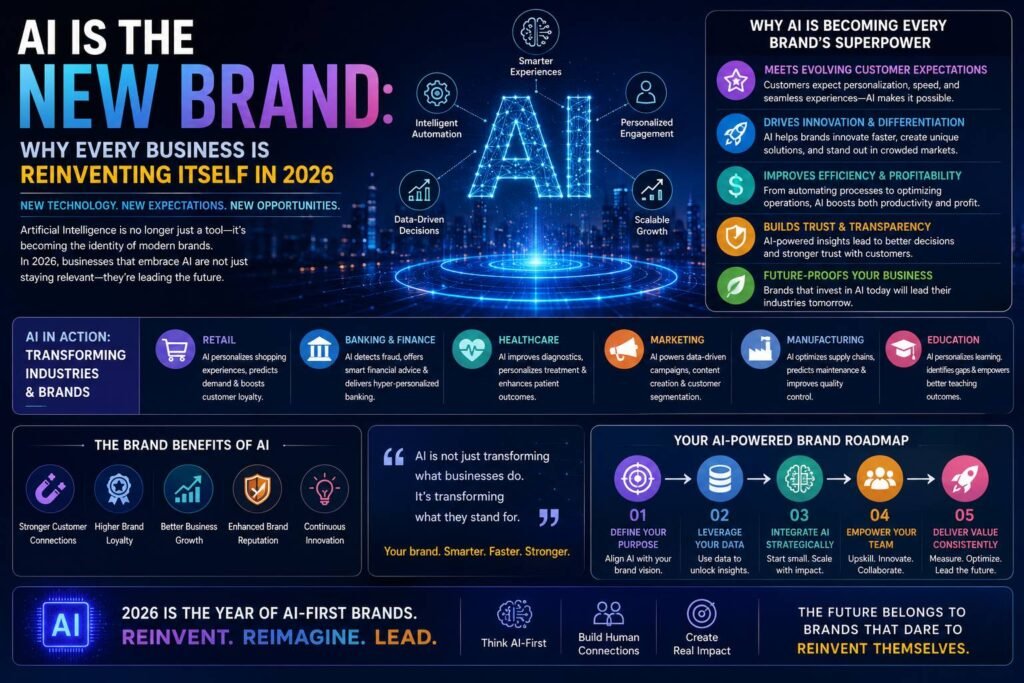

The Identity Shift That’s Reshaping Every Industry
Something fundamental has changed in how businesses present themselves to the world. In 2026, the question companies are fielding from customers, investors, and partners is no longer “What do you sell?” — it’s “How do you use AI?” Artificial intelligence has become the defining lens through which brand identity, competitive positioning, and customer trust are now evaluated. AI is the new brand, and every business is reinventing itself to reflect that reality.
This isn’t a trend driven purely by hype. It’s a structural shift in what consumers and stakeholders expect from the organizations they choose to engage with. Just as having a website was once a signal of legitimacy, and a social media presence later became table stakes, an intelligent, AI-powered operation is now the baseline expectation for any business that wants to be taken seriously.
Why AI Has Become a Brand Signal
Brand has always been about trust, differentiation, and the promise of consistent value. For decades, companies built brand equity through logos, taglines, customer service philosophies, and product quality. Those elements haven’t disappeared — but they’ve been joined by something more powerful: the visible intelligence of the organization itself.
When a customer interacts with a business today, they’re evaluating far more than the product. They’re assessing:
- How personalized and responsive the experience feels
- Whether the company anticipates their needs before they articulate them
- How efficiently problems are resolved
- Whether the business communicates with clarity and speed
All of these signals are now shaped, in large part, by how effectively a company has integrated artificial intelligence into its operations. A brand that delivers frictionless, hyper-personalized experiences is implicitly communicating that it is modern, capable, and invested in the customer relationship. A brand that still makes customers repeat themselves across channels, wait days for responses, or navigate clunky systems is communicating the opposite — regardless of how polished its visual identity might be.
Reinvention Is Not Optional
The phrase “every business is reinventing itself in 2026” might sound like marketing language, but the data supports it. Across sectors — from retail and finance to healthcare and logistics — organizations are restructuring workflows, rethinking customer touchpoints, and rewriting their value propositions around AI-driven capabilities.
This reinvention takes several distinct forms:
Operational Reinvention
Many businesses are deploying AI to transform internal processes — automating routine tasks, accelerating decision-making, and reducing the margin for human error. This operational efficiency doesn’t just cut costs; it frees human talent to focus on higher-order creative and strategic work. Companies that have made this shift are faster, more agile, and better positioned to respond to market changes. That agility becomes part of the brand.
Customer Experience Reinvention
AI-powered personalization has moved beyond product recommendations. Businesses are now using machine learning models to tailor pricing, communications, content, and support interactions at an individual level. The customer experience has become so differentiated that two people using the same platform may have entirely different journeys — each optimized for their behavior, preferences, and history. This level of responsiveness builds a kind of loyalty that traditional marketing campaigns simply cannot replicate.
Narrative Reinvention
Perhaps the most visible form of reinvention is the way companies are telling their stories. Brand messaging in 2026 frequently centers on AI capability as a core differentiator. Businesses are leading with their intelligent infrastructure in pitch decks, on websites, in advertising, and in executive communications. The companies winning attention and investment are those that can articulate not just what they do, but how their AI capabilities make them uniquely positioned to deliver it.
The Risk of Reinventing Without Substance
Not all AI-driven rebranding is authentic, and audiences are becoming sophisticated enough to notice the difference. Slapping “AI-powered” onto a product that hasn’t meaningfully changed is a short-term tactic with long-term consequences. In a landscape where AI is the new brand, credibility depends on demonstrating real capability — not just claiming it.
Businesses that are genuinely succeeding in this reinvention share a few characteristics:
- Transparency about how AI is used — customers and regulators increasingly demand clarity on where and how automated systems influence decisions
- Human oversight built into AI processes — the brands earning trust are those that position AI as an amplifier of human judgment, not a replacement for it
- Continuous improvement loops — rather than deploying AI as a one-time upgrade, leading organizations treat it as a living system that learns and evolves
Companies that treat AI as a cosmetic rebrand will find themselves exposed. Those that build genuine intelligence into their operations will find that the brand takes care of itself.
What This Means for Businesses of Every Size
One of the most significant aspects of the current moment is that AI-driven reinvention is not exclusive to large enterprises. Small and mid-sized businesses now have access to AI tools — in marketing, customer service, financial planning, and product development — that would have required enterprise-scale investment just a few years ago. The democratization of these capabilities means the competitive pressure is felt across the entire market.
A local law firm using AI to streamline document review and client communication is building a brand advantage over competitors who haven’t made that shift. A boutique retailer using predictive analytics to manage inventory and personalize outreach is competing more effectively against national chains. The playing field hasn’t been leveled — but it has been fundamentally altered.
Looking Ahead
The businesses that will define their industries over the next decade are the ones that understand what’s happening right now: AI is not a department, a tool, or a feature. It is the operating philosophy of the modern organization. It shapes how decisions are made, how customers are served, how talent is deployed, and how value is created.
Every business is reinventing itself in 2026 because the alternative — standing still while competitors evolve — is no longer a viable strategy. The brands that emerge strongest from this period will be those that treated artificial intelligence not as a trend to ride, but as a foundation to build on.
READ MORE:
Brand Transformation Through AI: Lessons from Reliance Power’s New Strategy
Why AI Is Becoming a Corporate Branding Strategy for Indian Companies
Why Reliance Power Is Entering the AI Business and What It Means for Investors
Published By Branding.net.in