
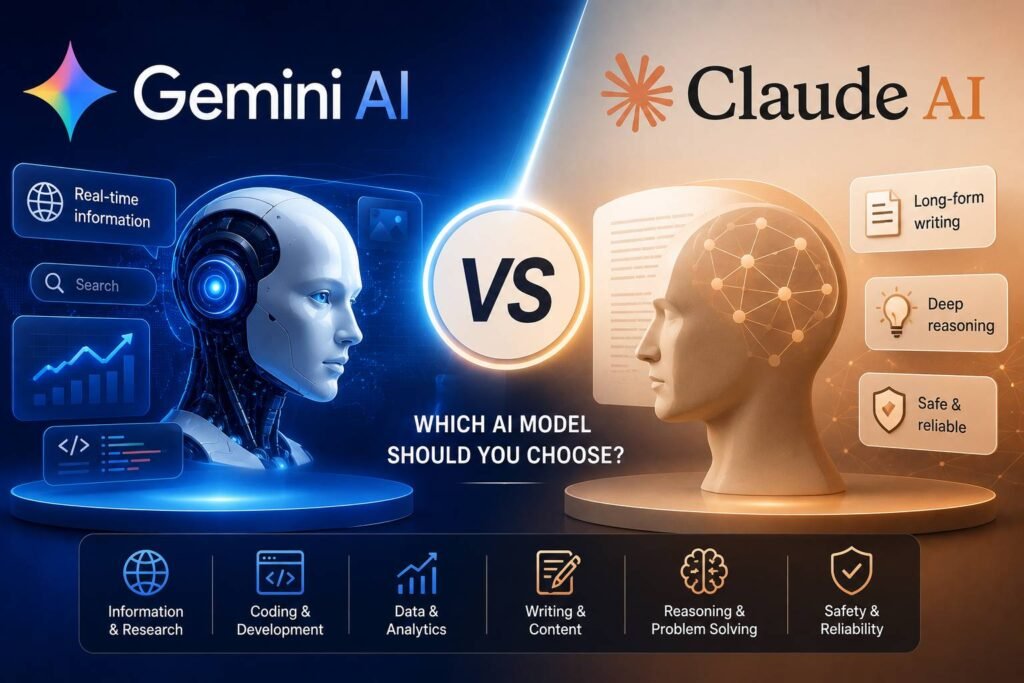

Two Powerful AI Assistants, One Important Decision
The artificial intelligence landscape has never been more competitive. Among the most discussed contenders today are Google’s Gemini AI and Anthropic’s Claude AI — two sophisticated large language models that have captured the attention of developers, businesses, students, and everyday users alike. If you’re weighing up Gemini AI vs Claude AI: which AI model should you choose? — this guide breaks down the key differences, strengths, and ideal use cases to help you make an informed decision.
What Is Gemini AI?
Gemini is Google’s flagship AI model, developed by Google DeepMind. It was built from the ground up to be natively multimodal, meaning it can process and reason across text, images, audio, video, and code simultaneously. Gemini is available in several versions — including Gemini Nano, Pro, and Ultra — catering to everything from on-device mobile tasks to enterprise-grade applications.
One of Gemini’s most significant advantages is its deep integration with Google’s ecosystem. Users of Google Workspace, Gmail, Google Docs, and Google Search benefit from Gemini’s embedded capabilities, making it a natural fit for anyone already living inside Google’s suite of tools.
Key strengths of Gemini AI:
- Native multimodal capabilities (text, image, video, audio, code)
- Tight integration with Google Search and Workspace
- Strong performance on real-time information retrieval
- Competitive coding and mathematical reasoning abilities
- Available across a wide range of devices through Google products
What Is Claude AI?
Claude is developed by Anthropic, an AI safety company founded by former members of OpenAI. Claude has earned a strong reputation for producing nuanced, thoughtful, and contextually rich text. Anthropic’s focus on “Constitutional AI” — a framework designed to make AI systems more aligned with human values — is deeply embedded in how Claude behaves.
Claude is particularly well-regarded for long-form writing, complex document analysis, and nuanced reasoning. Its extended context window (up to 200,000 tokens in Claude 3) allows it to process and analyze entire books, lengthy legal documents, or large codebases in a single session.
Key strengths of Claude AI:
- Exceptional long-form writing and editorial quality
- Industry-leading context window for document processing
- Strong focus on safety, honesty, and reduced hallucination
- Thoughtful, nuanced responses to complex or sensitive topics
- Excellent at summarization, analysis, and structured reasoning
Head-to-Head Comparison
Writing and Content Creation
When it comes to creative and professional writing, Claude consistently impresses with its natural prose, tone sensitivity, and ability to follow complex stylistic instructions. It produces content that feels less formulaic and more human. Gemini is also capable, but its writing can sometimes feel more utilitarian — particularly effective for structured content, templates, or technical documentation.
Winner: Claude AI for creative and editorial writing.
Research and Real-Time Information
Gemini has a clear advantage here due to its integration with Google Search. It can pull in current, up-to-date information from the web, making it far more reliable for research tasks that require recent data. Claude, by contrast, has a fixed knowledge cutoff and does not browse the internet by default.
Winner: Gemini AI for research and current events.
Coding Assistance
Both models perform well on coding tasks. Gemini benefits from Google’s vast technical training data and performs strongly with popular languages like Python, JavaScript, and SQL. Claude, particularly Claude 3 Opus, has shown impressive performance in understanding complex codebases and explaining code logic in plain language — a useful feature for developers who need more than just syntax generation.
Winner: Tie, depending on whether you prioritize generation speed or code comprehension.
Document and Data Analysis
This is where Claude genuinely excels. Its massive context window means you can upload lengthy PDFs, contracts, or research papers and ask detailed questions across the entire document. Gemini Pro can handle documents too, but Claude’s ability to maintain coherence across extremely long inputs is a standout capability.
Winner: Claude AI for deep document analysis.
Multimodal Tasks
If you need an AI that can interpret images, analyze video content, or process audio, Gemini is the stronger choice. Its multimodal architecture was a design priority, and it shows in the quality and breadth of visual and audio reasoning it can perform.
Winner: Gemini AI for multimodal use cases.
Pricing and Accessibility
Both models offer free tiers that give users a meaningful taste of their capabilities. Gemini is accessible through Google’s products, including a free version via Gemini.google.com and a premium tier through Google One. Claude is available at Claude.ai, with a free tier and a Pro subscription for heavier usage.
For API access, both platforms offer developer pricing, with costs varying based on model tier and token usage. Businesses should evaluate their expected usage volume and the specific capabilities they need before committing to a paid plan.
Which AI Model Should You Choose?
The answer depends entirely on your specific needs:
- Choose Gemini AI if you rely heavily on Google Workspace, need real-time web access, work with multimodal content, or want a tightly integrated assistant across Google’s ecosystem.
- Choose Claude AI if you prioritize writing quality, need to process large documents, value thoughtful and safety-conscious responses, or require nuanced reasoning on complex topics.
For many users, the ideal solution may not be choosing one over the other — both tools can complement each other depending on the task at hand. Developers and power users increasingly maintain access to multiple AI models, switching based on context.
Final Thoughts
The debate around Gemini AI vs Claude AI — which AI model should you choose? — doesn’t have a single universal answer. Gemini brings the power of Google’s infrastructure and real-time knowledge to the table, while Claude offers unmatched depth in writing, analysis, and long-context reasoning. Understanding your workflow, your priorities, and the types of tasks you need AI assistance with will ultimately guide you to the right choice. Try both, test them against your real-world use cases, and let performance — not hype — be your deciding factor.
READ MORE:
- Seedance AI: The Complete Guide to ByteDance’s AI Video Generator (2026)
- How to Create Cinematic AI Videos with Seedance AI
- How Seedance AI Is Changing Personal Branding Through Video
Published By Branding.net.in