
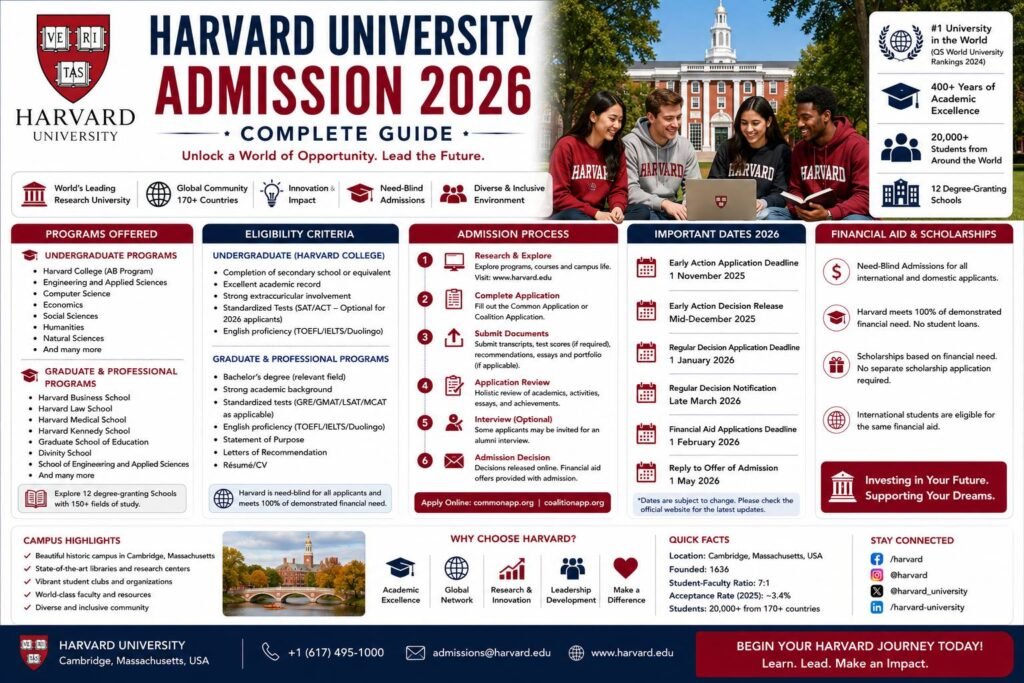

Overview of Harvard University Admission 2026
Harvard University remains one of the most sought-after institutions in the world, drawing hundreds of thousands of ambitious students to its application portal each cycle. For those aiming at Harvard University Admission 2026, understanding the process thoroughly — from deadlines to evaluation criteria — is essential for putting together a competitive application. This guide walks you through everything you need to know.
Key Deadlines for the 2026 Admission Cycle
Harvard offers two primary application pathways, each with distinct deadlines:
- Restrictive Early Action (REA): Application deadline is November 1, with decisions typically released in mid-December.
- Regular Decision (RD): Application deadline is January 1, with decisions released in late March.
Harvard’s Restrictive Early Action program is non-binding, meaning you are not obligated to enroll if admitted. However, it does restrict you from applying Early Action or Early Decision to other private institutions. Students who feel their application is strongest in the fall semester often benefit from applying REA.
Admission Requirements
Academic Credentials
Harvard evaluates applicants holistically, but academic excellence remains the foundation. Successful applicants typically present:
- A rigorous high school curriculum, including Advanced Placement (AP), International Baccalaureate (IB), or equivalent advanced coursework
- A GPA that places them at or near the top of their graduating class
- Strong performance across all subject areas, not just in a student’s area of interest
Standardized Testing
Harvard has reinstated its standardized testing requirement for the Class of 2029 and beyond. For Harvard University Admission 2026, applicants are expected to submit either SAT or ACT scores. The middle 50% range for admitted students typically falls between 1580–1600 on the SAT and 35–36 on the ACT, though students with scores slightly below these ranges have been admitted based on the strength of their overall profile.
Letters of Recommendation
Harvard requires:
- Two teacher recommendations from instructors who have taught you in core academic subjects
- One school counselor recommendation
- An optional supplemental recommendation is permitted if it adds meaningful new perspective
Choose recommenders who know you well and can speak to your intellectual curiosity, character, and contributions to the classroom environment.
The Application Components
Harvard accepts applications through the Common Application or the Coalition Application. Both platforms require the same core materials:
- Personal Essay – The Common App personal statement (650 words maximum)
- Harvard Supplemental Essays – Harvard typically asks one or more short-answer questions that allow students to share more about themselves, their intellectual interests, and what they would contribute to the Harvard community
- Activities List – Up to ten extracurricular activities, listed in order of importance to you
- School Report and Transcripts
- Standardized Test Scores
- Arts Supplement (optional) – For students with exceptional talent in music, visual arts, theater, or dance
What Harvard Looks for in Applicants
The Harvard admissions process is famously holistic. Admissions officers evaluate applicants across several dimensions:
Intellectual Curiosity and Academic Excellence
Harvard is looking for students who genuinely love learning — those who pursue ideas beyond the classroom, engage deeply with subjects, and demonstrate the capacity for original thought. Strong grades and test scores signal academic readiness, but intellectual passion is what distinguishes truly compelling applications.
Extracurricular Impact
Rather than a long list of clubs and activities, Harvard values depth over breadth. Admissions officers are more impressed by a student who has made a meaningful, sustained impact in one or two areas than by someone who has participated superficially in dozens of organizations. Leadership roles, entrepreneurial initiatives, research projects, and community impact carry significant weight.
Personal Character and Integrity
Harvard’s application asks counselors and teachers to evaluate personal qualities such as integrity, maturity, and concern for others. The university is building a community, and it prioritizes students who demonstrate genuine care for those around them.
Unique Perspective and Background
Harvard actively seeks to build a diverse class in every sense of the word — geographically, socioeconomically, culturally, and intellectually. Students who bring a unique perspective or have overcome significant challenges often stand out in the applicant pool.
Financial Aid and Affordability
One of the most compelling aspects of Harvard University Admission 2026 is the institution’s commitment to making education accessible regardless of financial background. Harvard’s financial aid program is among the most generous in the world:
- Families earning less than $85,000 per year typically pay nothing toward tuition, room, or board
- Families earning between $85,000 and $150,000 pay a modest percentage of their income
- Even families earning above $150,000 may qualify for need-based assistance
Harvard meets 100% of demonstrated financial need for all admitted students, and it does not offer merit-based scholarships — all aid is need-based. Prospective applicants should complete the CSS Profile and FAFSA to be considered for financial aid.
Acceptance Rates and Realistic Expectations
Harvard’s acceptance rate has hovered around 3–4% in recent years, making it one of the most selective universities in the world. For the Class of 2028, Harvard received over 54,000 applications and admitted approximately 1,937 students. These numbers underscore the importance of approaching the Harvard University Admission 2026 process with both ambition and a balanced college list.
Applying to Harvard should be part of a broader strategy that includes reach, match, and safety schools. Even the strongest applicants benefit from applying to multiple institutions where they would be happy to enroll.
Tips for a Strong Application
- Start early. Give yourself ample time to craft thoughtful essays and gather strong recommendations.
- Be authentic. Admissions officers read thousands of essays. Genuine voice and honest reflection stand out far more than polished but hollow writing.
- Show, don’t tell. Use specific examples and stories rather than broad claims about your qualities.
- Research Harvard specifically. Demonstrate that you understand what Harvard offers and how it aligns with your goals.
- Proofread thoroughly. Errors in your application signal a lack of care and attention to detail.
Final Thoughts
Preparing for Harvard University Admission 2026 is a significant undertaking, but with careful planning, self-reflection, and genuine effort, you can submit an application that represents the very best of who you are. Focus on telling your story compellingly, pursuing excellence in all areas, and approaching the process with both confidence and humility.
READ MORE:
- North East Christian University Admission 2026: Complete Guide
- Woxsen University Admission 2026: Complete Guide
- Bharathiar University Admission 2026: Complete Guide
Published by Branding.net.in