
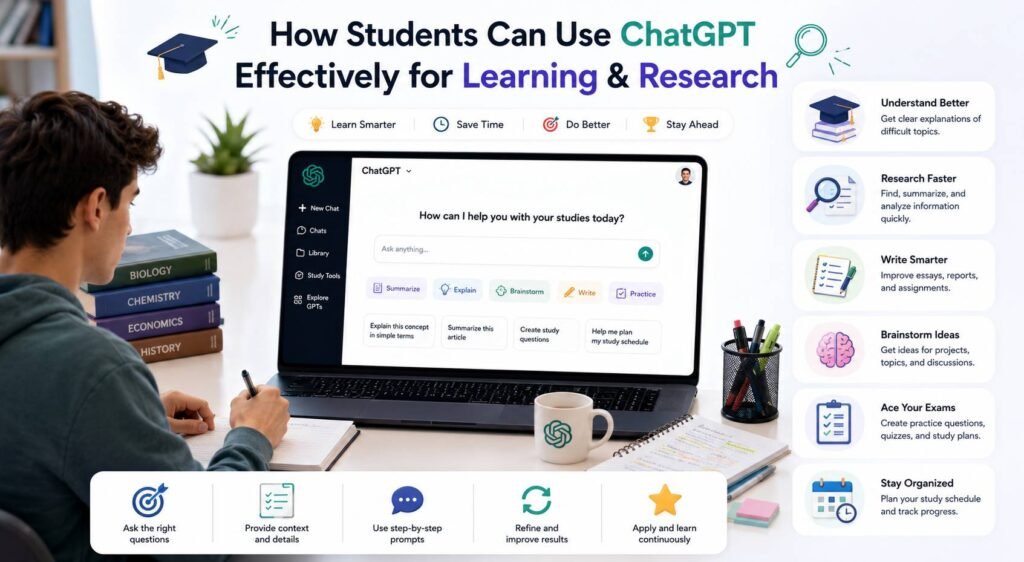

Walk into any hostel, library, or coaching centre today and you will find students quietly using ChatGPT to clear doubts, revise chapters, and finish assignments faster. It has become a regular part of student life across India.
In fact, India now makes up the largest share of ChatGPT mobile users in the world, and more than half of its users in India are below the age of 24. That tells you how important this tool has already become for learners.
The real question is no longer whether to use it, but how students can use ChatGPT effectively without falling into bad habits like copy paste and over dependence.
This guide gives you a clear, honest plan. You will learn the smart ways to use ChatGPT for studies and research, the mistakes to avoid, and how to keep your learning genuine. Whether you are a Class 12 board student, a JEE or NEET aspirant, a college fresher, or a UPSC hopeful, there is something here for you.
Why This Matters for Indian Students
The scale is huge. ChatGPT has crossed 100 million weekly active users in India, and a large part of that is students. Used well, it can act like a patient tutor who is awake at 2 am before your exam, ready to explain a concept in ten different ways until it finally clicks.
But here is the catch. The same tool can become a shortcut that quietly weakens your understanding if you let it think for you. So this whole guide is built around one idea.
Students can use ChatGPT effectively only when they treat it as a study partner, not a homework machine. Get that balance right and it becomes one of the best things on your phone.
The Golden Rule: A Helper, Not a Shortcut
Before the methods, set this rule in your mind. ChatGPT should help you learn, not learn on your behalf. If you simply copy its answer into your assignment, you gain nothing, you risk plagiarism, and you will struggle in the exam hall and the viva where the tool cannot reach you.
Use it to understand, practise, and improve your own work. A B.Com student in Delhi who asks it to explain a tricky accounting concept and then writes the answer herself learns far more than one who pastes a readymade reply. Keep your thinking in the loop, and everything below will actually make you smarter.
Getting Started in a Few Minutes
Setting up is simple. Download the app or open the website, and sign up with your email or Google account. The free version is enough for most student needs.
OpenAI has also launched a feature called Study Mode, which is free for users in India. Instead of just handing you the final answer, Study Mode guides you step by step, asks you questions, and helps you reach the answer yourself. For learning, this is the setting you want, because it builds understanding rather than spoon feeding it.
Also Read: How to Write Better Prompts for ChatGPT
Smart Ways Students Can Use ChatGPT Effectively
Here are the methods that genuinely help with learning and research. Pick the ones that match your course and exams.
1. Understand difficult concepts
Stuck on a topic that the textbook explains in confusing language? Ask ChatGPT to explain it simply with an everyday example. An engineering student in Pune can say “explain Fourier transform in simple words with a real life example,” and get a version that finally makes sense. Then ask follow up doubts until it is fully clear.
2. Make a study plan and timetable
Tell it your exam date, your subjects, and your weak areas, and ask for a realistic daily timetable. A NEET aspirant can get a balanced plan that gives more hours to Organic Chemistry while keeping Physics and Biology on track. You stay in charge and adjust it to suit your routine.
3. Summarise long chapters and notes
Paste your notes or a long passage and ask for a short summary with the key points. This is gold during revision, when you need to go through a full unit quickly. Ask for the summary in points so it is easy to remember.
4. Test yourself with practice questions
Ask it to create a quiz on any chapter, then answer without looking. “Give me 10 multiple choice questions on the French Revolution and check my answers.” This active recall is one of the most effective ways to study, far better than just reading again and again.
5. Revise smartly before exams
During last minute revision, ask for the most important points of a chapter, common question patterns, or quick formulas. A Class 12 CBSE student can ask “what are the most repeated types of questions from Electrostatics in board exams” and focus revision where it counts. Always cross check with your syllabus and past papers.
6. Improve your essays and assignments
Write your own draft first, then paste it and ask “how can I improve this essay” or “point out weak arguments and grammar mistakes.” You keep your own ideas and voice while making the work sharper. This is the honest way to use it, and it actually improves your writing skills over time.
7. Get direction for research projects
For a final year project or a college paper, use it to brainstorm topics, build an outline, and understand a research method. A student in Chennai working on a project can ask it to suggest a structure and explain a concept, then do the actual research and writing herself. Treat its output as a starting point to verify, never as a final source.
8. Practise spoken English and interviews
Placements and interviews need confidence in communication. Ask ChatGPT to act as an interviewer and ask you common HR questions, then give feedback on your answers. It is a judgement free way to practise as many times as you want before the real thing.
9. Solve doubts in coding and maths
Stuck on a programming error or a tough maths problem? Ask it to explain where you went wrong and walk you through the logic, rather than just giving the final code. Understanding the why is what helps you in the exam and the job.
10. Clear doubts any time of day
Not everyone has a teacher or senior available late at night. ChatGPT fills that gap. When a small doubt is blocking your progress, a quick, clear explanation keeps you moving instead of stuck.
Pro Tip: How to Use ChatGPT Effectively
How to Ask Good Questions and Get Good Answers
The quality of your answer depends on the quality of your question. Give ChatGPT four things: who it should be, the background, the task, and the format you want.
Weak: Explain photosynthesis.
Strong: Act as a friendly biology teacher. I am a Class 10 student preparing for board exams. Explain photosynthesis in simple words with one easy example, then give me three short questions to test myself. Keep it under 200 words.
The strong version is the kind of prompt that lets students use ChatGPT effectively, because it tells the tool exactly what you need and at what level.
Mistakes Students Should Avoid
A few common habits can do more harm than good.
- Copying answers directly. This is plagiarism and it leaves you blank in exams. Always write in your own words.
- Trusting every fact. ChatGPT can give wrong dates, formulas, or facts with full confidence. Always verify against your textbook or a trusted source.
- Skipping your own thinking. If you stop attempting questions on your own, your problem solving skill will fade.
- Vague questions. “Explain economics” gives you nothing useful. Be specific about the topic and your level.
- Over dependence. Use it to support your study, not replace your effort and your teachers.
Stay Honest and Stay Safe
Two simple habits protect you. First, always check important facts, because the tool can make mistakes, especially in numerical and factual answers. Second, do not share private details like your full personal information or anything sensitive. Use it as a learning aid, follow your college rules on AI use, and let your own understanding remain the real source of your marks.
A Simple Daily Study Routine with ChatGPT
Try this for one week and see the difference.
- Start of the day: Ask for a focused study plan based on your exam date and weak topics.
- While studying: Use it to clear doubts and understand tough concepts in simple words.
- After each topic: Ask for a short quiz and test yourself without looking.
- End of the day: Get a quick summary of what you covered and a small plan for tomorrow.
Keep a note of the prompts that work well for you. Slowly you will build your own collection that makes daily study faster and easier.
Explore The 25 Practical Ways to Use ChatGPT
Frequently Asked Questions
How can students use ChatGPT effectively for studies?
Use it to understand concepts, make study plans, summarise chapters, and test yourself with practice questions. Always write your own answers and verify facts, so it supports your learning instead of replacing it.
Is it cheating to use ChatGPT for assignments?
Copying its answer into your assignment is plagiarism. Using it to understand a topic, improve your own draft, or brainstorm ideas is a fair and helpful way to study. Follow your college rules.
Is ChatGPT free for students in India?
Yes, there is a free version that covers most student needs, and OpenAI has rolled out a free Study Mode in India that guides you step by step through problems.
Can I trust ChatGPT for facts and formulas?
Not fully. It can sound confident and still be wrong. Always cross check important dates, facts, and formulas with your textbook or a trusted source.
Which is the best way to revise with ChatGPT?
Ask it to create quizzes and short summaries of each chapter, then answer the questions from memory. This active recall method is one of the most effective ways to revise before exams.
Final Thoughts
ChatGPT is one of the most powerful study tools that students in India have ever had access to. But like any tool, the result depends on how you use it. Students can use ChatGPT effectively when they treat it as a tutor that explains, tests, and guides, while keeping their own thinking and honesty at the centre. Use it to learn faster, not to skip learning. Pick one method from this guide, like making a quiz on your weakest chapter, and try it during your study session today. That small habit, repeated daily, is what turns a chatbot into a genuine study partner.
Published By Branding.net.in