
What Is Branding? A Clear Definition
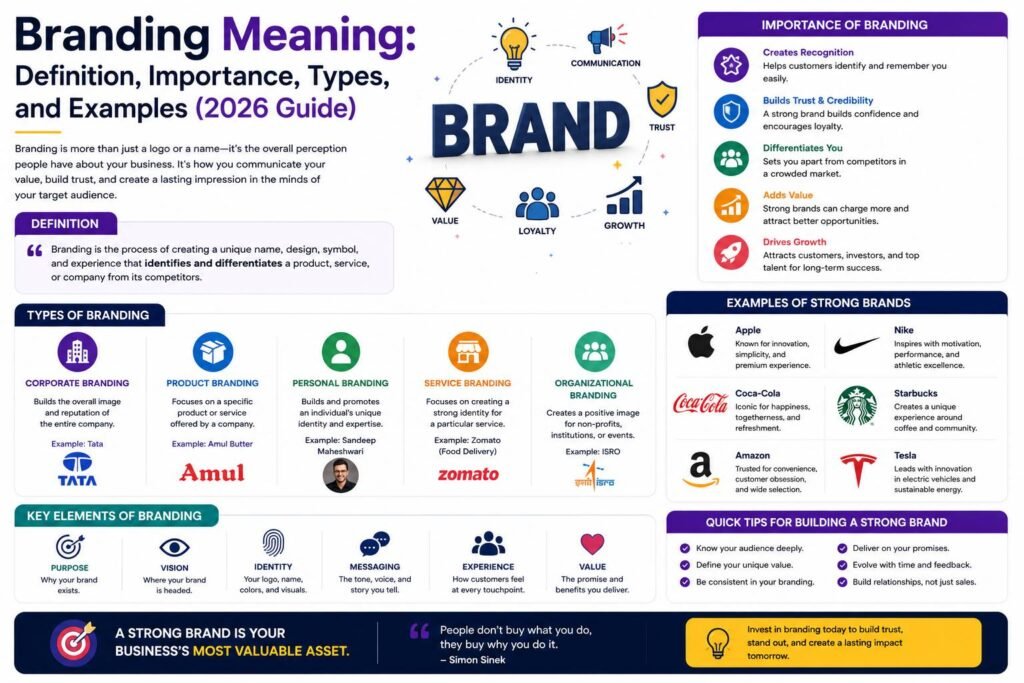
At its core, branding meaning refers to the process of creating a distinct identity for a product, service, company, or individual in the minds of consumers. It goes far beyond designing a logo or choosing a color palette. Branding encompasses every touchpoint a customer has with your business — from the way your emails are written to the experience of unboxing your product.
A useful working definition: branding is the strategic practice of shaping perception. It is the deliberate effort to communicate who you are, what you stand for, and why someone should choose you over every alternative in the market.
In 2026, with markets more saturated than ever and consumer attention spans shorter than a decade ago, understanding branding meaning in its full depth is not optional — it is a fundamental business requirement.
Why Branding Matters More Than Ever
The importance of branding cannot be overstated in today’s competitive landscape. Here is why it deserves serious strategic investment:
- Trust and credibility: A consistent, professional brand signals reliability. Consumers are far more likely to purchase from a company that presents itself coherently and confidently.
- Customer loyalty: Strong brands create emotional connections. When customers feel aligned with a brand’s values, they return — and they refer others.
- Premium pricing power: Well-branded companies can charge more for the same product. Apple and Nike are classic examples of brands commanding price premiums purely on perceived value.
- Employee attraction and retention: People want to work for brands they believe in. A compelling brand identity helps attract talent who are genuinely invested in the mission.
- Market differentiation: In crowded industries, branding is often the primary differentiator. When products are functionally similar, the brand becomes the deciding factor.
Research consistently shows that consistent brand presentation across all platforms can increase revenue by up to 23%. That figure alone illustrates why branding deserves a seat at the executive table.
The Core Elements of a Brand
Understanding branding meaning requires unpacking its key components. A fully realized brand is built from several interlocking elements:
Brand Identity
This is the visual and verbal language of your brand — logos, typography, color systems, tone of voice, and taglines. Identity is what people see and hear.
Brand Positioning
Positioning defines where your brand sits in the market relative to competitors. It answers the question: For whom are we the best choice, and why?
Brand Values
These are the principles that guide your organization’s decisions. Values are not marketing copy — they must be lived internally before they can be communicated externally.
Brand Voice and Tone
How a brand communicates matters as much as what it communicates. A financial services firm and a streetwear label may both be trustworthy, but they express that trust very differently.
Brand Experience
Every interaction a customer has with your business — from a customer service call to your website’s loading speed — contributes to the overall brand experience.
Types of Branding
Branding is not a one-size-fits-all discipline. Different contexts call for different approaches:
Corporate Branding
This focuses on building the reputation of an entire organization rather than a single product. Companies like IBM or Microsoft invest heavily in corporate branding to maintain trust across diverse product lines.
Product Branding
Product branding gives individual items their own identity. Think of Coca-Cola’s distinct branding for Sprite, Fanta, and its flagship cola — each has a separate personality within the same corporate umbrella.
Personal Branding
In 2026, personal branding is more relevant than ever. Entrepreneurs, executives, consultants, and creators deliberately shape how they are perceived professionally. LinkedIn profiles, speaking engagements, and social media presence all contribute to a personal brand.
Service Branding
Service-based businesses — law firms, agencies, healthcare providers — use branding to communicate expertise, empathy, and reliability, since there is no physical product to evaluate before purchase.
Geographic Branding
Cities, regions, and countries brand themselves to attract tourism, investment, and talent. “I ♥ NY” remains one of the most recognized geographic branding campaigns in history.
Employer Branding
This is a company’s reputation as a place to work. Organizations with strong employer brands attract better candidates and reduce hiring costs significantly.
Real-World Branding Examples
Apple
Apple’s branding meaning is rooted in simplicity, creativity, and human-centered design. Every element — from minimalist packaging to the clean lines of their retail stores — reinforces the same message: technology should feel intuitive and beautiful. Apple rarely competes on price; it competes on identity.
Patagonia
Patagonia has built one of the most authentic brand identities in the outdoor industry by genuinely committing to environmental activism. Their famous “Don’t Buy This Jacket” campaign challenged consumerism directly — and paradoxically strengthened customer loyalty because it felt honest.
Airbnb
Airbnb’s “Belong Anywhere” positioning transformed a simple accommodation platform into a brand built around human connection. Their branding communicates warmth, adventure, and community — qualities that differentiate them sharply from traditional hotel chains.
Duolingo
Duolingo’s mascot-driven, humorous brand voice has made language learning feel approachable and entertaining. Their social media presence is bold, self-aware, and distinctly different from anything else in the education space — proving that even a utility product can build a personality-driven brand.
Building Your Brand: Where to Start
If you are developing or refreshing a brand in 2026, consider this foundational sequence:
- Define your purpose — Why does your business exist beyond making money?
- Know your audience — Who are you serving, and what do they genuinely care about?
- Audit your competition — Where is white space in the market you can credibly own?
- Articulate your positioning — Craft a clear statement of who you are and for whom.
- Develop your identity — Build the visual and verbal system that expresses your positioning.
- Activate consistently — Apply your brand across every channel and touchpoint without compromise.
Branding is not a one-time project. It is an ongoing commitment to showing up consistently and evolving thoughtfully as your market and audience change.
Final Thoughts
The full branding meaning encompasses strategy, creativity, psychology, and execution working in harmony. It is the difference between a business that merely exists and one that is genuinely remembered, preferred, and trusted. In a world where consumers have infinite choices and shrinking patience, a clear and compelling brand is one of the most valuable assets any organization can build.
READ MORE:
- Personal Branding Mistakes That Can Hurt Your Career
- What Is a Branding Agency? Services, Benefits, and How to Choose the Right One
- How to Choose the Best Branding Agency for Your Business in India
Published by Branding.net.in