
Why Personal Branding Matters More Than Ever
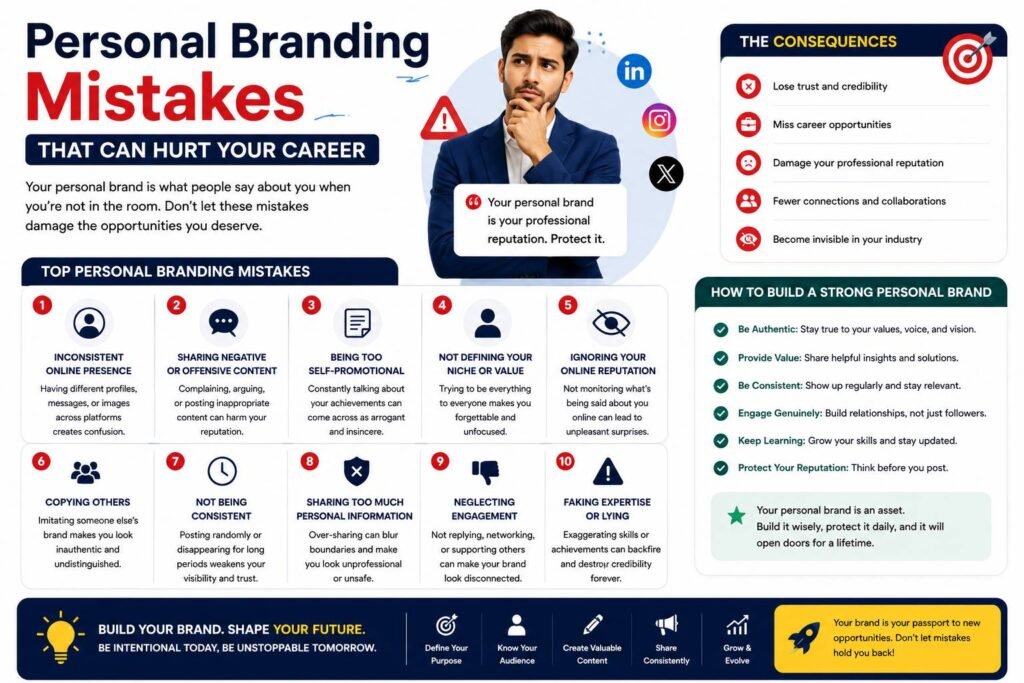
In today’s hyper-connected professional landscape, your personal brand is often the first impression you make — long before a handshake or interview. It shapes how colleagues, clients, and employers perceive your expertise, values, and reliability. Yet despite its importance, many professionals unknowingly make personal branding mistakes that can hurt your career in ways that are difficult to reverse.
Understanding what these mistakes look like — and how to avoid them — can mean the difference between a thriving professional reputation and one that quietly works against you.
Inconsistency Across Platforms
One of the most damaging things you can do is present a fragmented identity across different channels. If your LinkedIn profile describes you as a strategic marketing leader, but your personal website positions you as a freelance graphic designer, and your Twitter bio says “coffee enthusiast and occasional blogger,” you create confusion rather than clarity.
Recruiters, clients, and collaborators want to understand who you are and what you offer at a glance. Inconsistency signals a lack of direction and makes it harder for others to advocate for you or refer opportunities your way.
What to do instead:
- Audit all your professional profiles regularly
- Use a consistent headshot, bio, and value proposition
- Align your messaging with where you want your career to go, not just where it has been
Trying to Appeal to Everyone
Another critical error is casting too wide a net. Many professionals fear that narrowing their focus will limit their opportunities, so they position themselves as generalists who can do everything. In reality, this approach dilutes your brand and makes you memorable to no one.
The strongest personal brands are built on a clear niche. Specialists are sought out. Generalists are overlooked. When you define your area of expertise with precision, you become the go-to person in that space — and that specificity accelerates career growth far more effectively than vague, all-encompassing claims.
Neglecting Your Online Presence
In the digital age, silence is not neutral. If someone searches your name and finds nothing — or worse, finds outdated or irrelevant content — it raises questions about your engagement with your field. Among the personal branding mistakes that can hurt your career, neglecting your digital footprint is one of the most common and most correctable.
This doesn’t mean you need to be on every platform. It means being intentional and active on the platforms that matter most for your industry. Regularly share insights, comment thoughtfully on industry conversations, and keep your profiles current. A dormant LinkedIn profile from 2019 sends a quiet but powerful message that you’re not engaged.
Letting Your Personal and Professional Worlds Collide Carelessly
There’s a difference between being authentic and being unfiltered. Sharing your values and personality is a strength — it humanizes your brand and builds genuine connection. However, posting inflammatory political rants, venting about former employers, or sharing inappropriate humor can permanently damage your professional image.
Before posting anything publicly, ask yourself: Does this content reflect the professional I want to be known as? What you publish online is essentially a permanent record. Even deleted posts can be screenshotted and shared. Protecting your reputation requires consistent judgment, not just occasional caution.
Failing to Demonstrate Real Value
A personal brand isn’t just a polished headshot and a well-worded bio. It must be backed by substance. One of the most overlooked personal branding mistakes that can hurt your career is focusing entirely on aesthetics while neglecting proof of expertise.
Ask yourself: Are you sharing knowledge that helps others? Are you publishing articles, case studies, or thought leadership content that demonstrates what you actually know? Are you speaking at events, contributing to industry publications, or building a portfolio that showcases your results?
Your brand should be a window into your capabilities, not just a marketing exercise. When the style outpaces the substance, people notice — and trust erodes quickly.
Ignoring the Power of Networking and Relationships
Personal branding is not a solo act. Many professionals make the mistake of treating it as a one-way broadcast — pushing out content without investing in genuine relationships. Your network amplifies your brand. The people who vouch for you, refer you, and collaborate with you are often more powerful than any post you publish.
Neglecting to nurture professional relationships, failing to engage meaningfully with others’ content, or only reaching out when you need something are habits that quietly undermine your reputation over time.
Strong personal brands are built on:
- Genuine reciprocity and mutual support
- Consistent engagement, not just self-promotion
- Building community rather than just an audience
Copying Someone Else’s Brand
Inspiration is healthy. Imitation is counterproductive. Mimicking another professional’s tone, visual identity, or content strategy — even unintentionally — strips your brand of its most powerful asset: authenticity.
People connect with what is real and distinctive. Your unique combination of experiences, perspective, and personality cannot be replicated, and it shouldn’t be suppressed. The most compelling personal brands are rooted in genuine self-awareness, not in reverse-engineering someone else’s success.
Not Evolving as Your Career Grows
Finally, treating your personal brand as a static entity is a mistake that catches many professionals off guard. Your brand should evolve as your skills, goals, and industry evolve. Clinging to an outdated identity — or failing to communicate your growth — can leave you stuck in a box that no longer fits.
Schedule regular brand reviews. Reflect on whether your current positioning accurately represents where you are and where you’re heading. Update your narrative to reflect new accomplishments, pivots, and perspectives.
Moving Forward With Intention
The personal branding mistakes that can hurt your career are rarely dramatic in isolation — they accumulate quietly over time. The good news is that most of them are entirely preventable with awareness and consistent effort. By showing up authentically, communicating with clarity, and backing your brand with genuine expertise, you build a professional reputation that opens doors rather than closing them.
READ MORE:
- Personal Branding for Beginners: The Complete Guide for 2026
- How to Use Freepik to Build a Strong Personal Brand on Social Media
- What Is Freepik? A Complete Guide for Designers and Content Creators in 2026
Published by Branding.net.in