
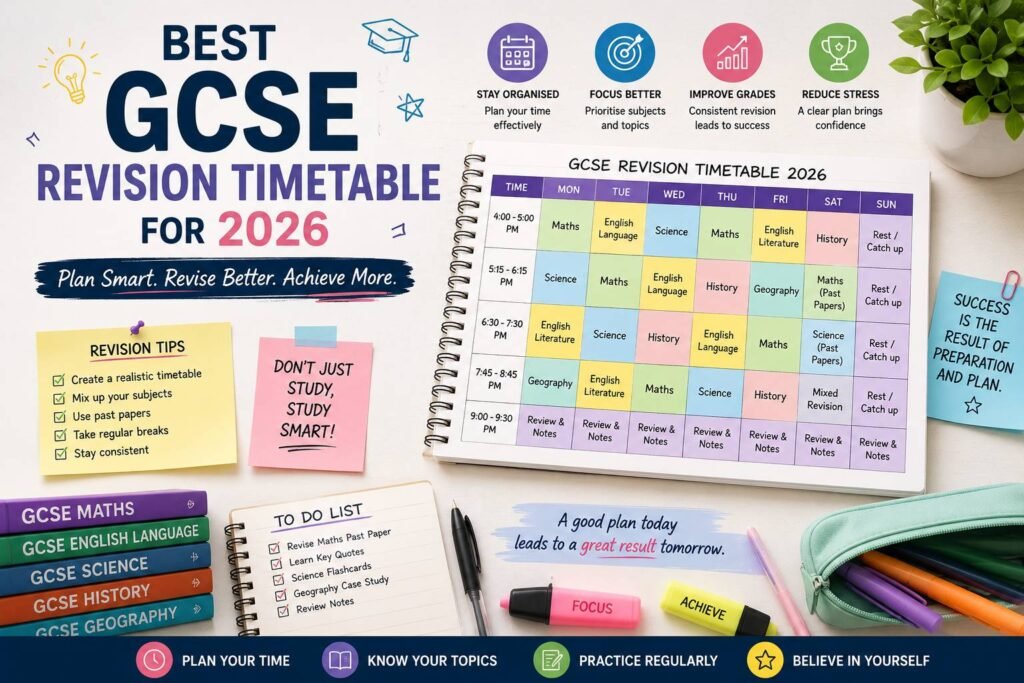

Introduction: The Difference Between Planning and Hoping
Every year, thousands of GCSE students sit down in May knowing, with a quiet sense of regret, that they should have started revising earlier. They spent the weeks before exams in a cycle of last-minute cramming, passive re-reading, and increasing anxiety rather than the structured, confident preparation that actually produces good results.
The good news: you do not have to be one of them.
The most consistent difference between students who hit their target grades and students who fall short is not raw ability. It is planning. A well-constructed GCSE revision timetable takes the daily question of “what should I be revising right now?” entirely off the table, freeing your mental energy for actually learning the material rather than stressing about where to start.
GCSE exams in England in 2026 run from Monday 4th May to Friday 26th June, with results day on Thursday 20th August. That means revision season is either already underway or very close to beginning. This guide will show you exactly how to build a revision timetable that works, how much time to commit depending on your grade goals, and which techniques to use to make every revision session count.
Let us plan your way to exam success.
Section 1: Why Every GCSE Student Needs a Revision Timetable
Better Time Management
Without a timetable, most students default to revising whatever feels easiest or whatever subject they happen to think of first. This creates a pattern where confident subjects get over-revised and weaker subjects, the ones where marks are actually available to be gained, get avoided entirely.
A timetable distributes your time deliberately, ensuring that every subject gets adequate attention and that the subjects where you have the most to gain receive the most focus.
Reduced Exam Stress
Anxiety about exams is largely anxiety about uncertainty, not knowing whether you have covered enough, whether you are prepared, whether there is something you have missed. A timetable converts that uncertainty into a plan. When you know you have scheduled every subject and followed that plan consistently, you can go into the exam room with a genuine sense of preparation rather than fingers-crossed hope.
Improved Retention
The brain does not retain information from passive reading alone. Effective revision requires active engagement with material and spacing that revision out over time rather than cramming it into a single session. A well-structured timetable builds in the spaced repetition that memory science consistently identifies as the most effective learning strategy.
Confidence Before Exams
Students who have followed a structured revision plan in the weeks before exams consistently report higher confidence on results day. That confidence is not unfounded. It comes from knowing they have done the work.
Section 2: When Should You Start Revising for GCSEs in 2026?
The Honest Timeline
Now, if your exams are approaching. With GCSE 2026 exams starting on 4th May, if you are reading this in March, April, or May, the intensive revision period is here.
January to March: Structured preparation. This is the ideal phase for a full revision timetable, working systematically through all subjects, identifying gaps, and building a foundation of knowledge before the final push.
Year 10 and early Year 11: Light touch consolidation. Students who start making short revision notes, using flashcards, and reviewing material after lessons in Year 10 and early Year 11 give themselves an enormous advantage. This is not about intense sessions. It is about ensuring material does not need to be completely relearned from scratch when revision season begins.
Key Dates for 2026
| Date | What It Means for Revision |
|---|---|
| Now (January to April) | Intensive timetabled revision across all subjects |
| 4 May 2026 | First GCSE exams begin |
| 11 May | English Literature Paper 1 (AQA, Edexcel, OCR) |
| 14 May | Maths Paper 1 Non-Calculator (all boards) |
| 3 June | Maths Paper 2 Calculator (all boards) |
| 10 June | Maths Paper 3 Calculator (all boards) |
| 26 June | Last day of GCSE exams |
| 20 August 2026 | Results Day |
Always check your personal exam timetable with your school and confirm with your exam board: AQA, Edexcel, or OCR.
Section 3: How to Create Your GCSE Revision Timetable Step by Step
Step 1: List All Your Subjects
Write down every GCSE subject you are sitting. Most students sit nine to eleven subjects. For each one, note the exam board and how many papers it involves.
Example:
- Maths (AQA) 3 papers
- English Language (AQA) 2 papers
- English Literature (AQA) 2 papers
- Combined Science (AQA) 6 papers
- History 2 papers
- Geography 3 papers
- French 3 papers
- Drama 1 written paper plus coursework
- Art Portfolio already submitted
Step 2: Identify Your Strong and Weak Areas
For each subject, rate your current confidence honestly: Strong, Comfortable, Needs Work, or Urgent.
Your weakest subjects need the most time, not your strongest. This is the step most students get wrong. Revising content you already know feels comfortable and productive but delivers fewer additional marks than revising content you genuinely struggle with.
Step 3: Calculate Your Available Study Time
Work out how many hours per week you realistically have for revision. Account for:
- School hours (these do not count)
- Mealtimes and family commitments
- Sleep (aim for 8 to 9 hours for a teenage brain)
- Exercise and social time (genuinely important, do not eliminate these)
- Downtime
Most students in active revision season can manage 2 to 4 hours of quality revision per day outside school. Quality matters more than quantity.
Step 4: Prioritise Your Subjects
Based on Steps 1 to 3, allocate revision time proportionally:
- Urgent or Needs Work subjects: more sessions per week
- Comfortable subjects: 1 to 2 sessions per week for maintenance
- Strong subjects: occasional past paper practice to maintain
Step 5: Schedule Regular Revision Sessions
Assign subjects to specific time slots rather than leaving it open-ended. Sessions of 45 to 60 minutes with a 10 to 15 minute break are more effective than long, unbroken periods of passive reading.
Aim to vary subjects across the day rather than spending an entire day on one subject. Variety improves engagement and memory consolidation.
Step 6: Include Breaks, Exercise, and Rest Days
A revision timetable without rest is unsustainable and counterproductive. Build in:
- Short breaks every 45 to 60 minutes
- At least one half-day off each weekend
- Regular physical activity. Even a 20-minute walk significantly improves cognitive function and memory
- Consistent bedtime. Sleep is when memory consolidation happens
Section 4: Sample GCSE Revision Timetable for 2026
Here is a realistic weekly revision schedule for a Year 11 student in April and May 2026, with exams beginning on 4th May.
| Time | Monday | Tuesday | Wednesday | Thursday | Friday | Saturday | Sunday |
|---|---|---|---|---|---|---|---|
| After school (4:30 to 5:30pm) | Maths: Past paper questions | English Lit: Poetry analysis | Science: Biology revision | History: Exam technique | Maths: Calculator practice | FREE | FREE |
| Break (5:30 to 5:45pm) | Break | Break | Break | Break | Break | ||
| Evening 1 (5:45 to 6:45pm) | Geography: Key case studies | French: Vocabulary | Science: Chemistry | English Lang: Reading skills | Geography: Past paper | Maths: Topic review | English Lit: Novel revision |
| Evening 2 (7:30 to 8:30pm) | English Lang: Writing practice | Science: Physics | History: Source skills | French: Writing practice | Rest or light reading | Science: Past paper | Free time or social |
| Before bed | Review flashcards (10 mins) | Review flashcards (10 mins) | Review flashcards (10 mins) | Review flashcards (10 mins) | Review flashcards (10 mins) |
Weekly total: Approximately 14 to 16 hours of structured revision
Rest: Saturday morning and Sunday evening fully free
Subjects covered: All core and option subjects at least once per week
Adjust this template based on your own exam dates. Front-load revision for subjects examined in early May.
Section 5: GCSE Revision Timetable by Grade Goal
Students Targeting Grades 4 to 5 (Standard Pass)
Daily study time: 1.5 to 2 hours outside school
Focus: Core subjects (Maths, English, Science) above all. Cover content once thoroughly, practise past papers for exam technique, and focus on understanding mark schemes.
Strategy: Prioritise breadth over depth. Make sure you have covered every topic rather than mastering a few. Learn the command words in mark schemes such as “describe,” “explain,” and “evaluate,” and practise structuring answers accordingly.
Students Targeting Grades 6 to 7
Daily study time: 2 to 3 hours outside school
Focus: All subjects need attention. Identify the mark-earning techniques for each subject such as extended writing in Humanities, calculation accuracy in Maths and Science, and language analysis in English.
Strategy: Past papers are essential at this level. Work through mark schemes carefully after each practice paper. Identify where marks are consistently lost and target those gaps specifically.
Students Targeting Grades 8 to 9
Daily study time: 3 to 4 hours outside school
Focus: Every subject, every topic, with genuine depth. At grades 8 to 9, examiners are looking for analysis, evaluation, and sophisticated understanding, not just content recall.
Strategy: Practise under timed exam conditions. Review high-level exemplar answers from your exam board. Ask teachers to review your extended answers and identify where you are losing the final marks. Read widely around subjects. English Literature and Humanities particularly reward students who bring wider reading to their answers.
Section 6: How Much Revision Should GCSE Students Do?
Quality Over Quantity
Research in learning science consistently shows that active, engaged revision such as quizzing yourself, practising questions, and teaching concepts back produces significantly better retention than passive re-reading for double the time.
Forty-five focused minutes of active recall beats two hours of passively re-reading notes. Every time.
Recommended Hours by Stage
| Revision Phase | Recommended Daily Hours | Notes |
|---|---|---|
| Year 10 and Early Year 11 | 30 to 45 mins | Consolidation and note-making |
| January to March Year 11 | 1 to 2 hours | Structured timetabled revision |
| April (4 to 6 weeks before exams) | 2 to 3 hours | Intensive timetabled revision |
| May to June (exam period) | 1.5 to 2.5 hours | Mixed revision and exam days |
Avoiding Burnout
Revision that leads to exhaustion and anxiety is not effective revision. If you notice you are reading the same paragraph repeatedly without absorbing it, you have hit your cognitive limit for that session. Take a proper break, walk, eat, rest, before continuing. Burning through 7 to 8 hours in one day and then being too exhausted to study for three days is a worse outcome than 2.5 focused hours every day.
Section 7: Best Revision Techniques for GCSEs
Active Recall
The single most evidence-backed revision technique. Rather than reading notes passively, close them and try to recall the information from memory. Use flashcards, cover-and-write, or simply write down everything you remember about a topic before checking. The act of retrieval, struggling to remember, is what embeds information.
Tools: Anki (free spaced repetition flashcard app), handwritten flashcard sets, revision question cards
Past Papers
Doing past papers under timed conditions is the most direct exam preparation available. It familiarises you with question styles, teaches you to manage time under pressure, and reveals exactly which topics you do not yet know well enough.
Always mark your past papers against the official mark scheme, not guesswork. Understanding why an answer earns marks is more valuable than knowing the answer itself.
Spaced Repetition
Reviewing material at increasing intervals, today, in three days, in a week, in two weeks, produces dramatically better long-term retention than reviewing it repeatedly in a short period. The Anki app does this automatically. If using physical flashcards, separate them into “learning,” “almost there,” and “know it” piles and revisit accordingly.
The Feynman Technique
Explain a concept as if teaching it to someone with no prior knowledge. Where you struggle to explain clearly, you have found a gap in your understanding. Fill the gap, then try again. This is particularly powerful for Science and Maths topics where conceptual understanding is tested alongside factual recall.
Mind Maps and Diagrams
Effective for visual learners and for mapping connections between ideas, particularly in subjects like History, Geography, and Biology where topics interrelate. Use sparingly: creating a beautiful mind map is not the same as learning the content on it.
Section 8: Common GCSE Revision Timetable Mistakes
Setting an unrealistic timetable. If your timetable requires superhuman levels of discipline from day one, it will collapse within a week. Start with achievable session lengths and build gradually.
Ignoring your weakest subjects. The subjects you avoid are usually the ones where you have the most marks to gain. Force yourself to schedule these first. Get the hard work done early in each session when focus is highest.
Passive revision. Re-reading highlighted notes feels productive and is almost entirely ineffective. Every session should involve actively testing yourself, not reading about what you should know.
No breaks. A timetable that runs from 6pm to 10pm without a break is less effective than a session from 6pm to 7pm with a break followed by 7:30pm to 8:30pm fully rested. Build breaks in and take them.
Last-minute cramming. The night before an exam, revision should be light. A brief review of key points, not a desperate attempt to cover new material. Your brain needs sleep to consolidate everything it has learned. A good night’s rest before an exam is more valuable than two extra hours of exhausted cramming.
Section 9: GCSE Revision Tips for Exam Season
Sleep Is Non-Negotiable
Memory consolidation happens during sleep. Teenagers need 8 to 9 hours. Cutting sleep to create more revision time is counterproductive. The additional revision time you gain is less effective than the consolidation you lose. Consistent bedtime and wake times stabilise mood and cognitive performance.
Move Every Day
Regular physical activity, even a 20 to 30 minute walk, improves blood flow to the brain, reduces stress hormones, and directly improves cognitive performance and memory. Do not eliminate exercise from your schedule during exam season. It is not a luxury. It is part of effective revision.
Eat Properly
Skipping breakfast before a morning exam, relying on caffeine and sugar for energy, or eating poorly throughout revision season all impair cognitive function. Regular meals with protein, complex carbohydrates, and adequate hydration support concentration and memory.
Talk to Someone If It Gets Too Much
Exam pressure is real and significant. If anxiety is becoming overwhelming, affecting sleep, appetite, or daily functioning, talk to a trusted teacher, a parent, or a school counsellor. Most schools have pastoral support specifically for exam season. Asking for help is a sign of good judgement, not weakness.
Section 10: Your Free GCSE Revision Planner Template
Use this weekly template as a starting point. Print it out, fill in the boxes, and stick it somewhere visible.
| Time Slot | Mon | Tue | Wed | Thu | Fri | Sat | Sun |
|---|---|---|---|---|---|---|---|
| 4:30pm | |||||||
| 5:45pm | |||||||
| 7:30pm | FREE | FREE |
Week of: ________________ Target this week: ________________
Subjects to cover this week:
- Subject 1: _______________
- Subject 2: _______________
- Subject 3: _______________
- Subject 4: _______________
- Subject 5: _______________
- Subject 6: _______________
Past papers planned: _______________ and _______________
What went well this week: _____________________________________________________________
What to adjust next week: _____________________________________________________________
At the start of each week, fill in subject slots based on upcoming exam dates and your current priority list. Review at the end of the week to adjust the following week’s plan.
Frequently Asked Questions
When should I start my GCSE revision timetable in 2026?
Ideally, a structured timetable should begin in January or February of Year 11, which is four to five months before the first exams. If you are reading this in April or May, start immediately with a realistic but intensive schedule. GCSE 2026 exams begin on 4th May and run to 26th June. Every week of structured revision before that window matters.
How many hours a day should I revise for GCSEs?
In the intensive period from April onwards, most students manage 2 to 3 hours of quality revision per day outside school hours. Quality matters more than quantity. Two hours of active recall and past paper practice is more valuable than 5 hours of passive re-reading. Avoid burning out by including breaks and at least one rest period per week.
How do I make a GCSE revision timetable?
List all your subjects, identify which are strongest and weakest, calculate available study time each week, and assign subjects to specific time slots. Prioritise weaker subjects as they have the most marks available to gain. Include breaks, exercise, and rest days. Review the plan weekly and adjust based on upcoming exam dates and progress.
What are the best revision techniques for GCSEs?
Active recall (testing yourself from memory), past papers under timed conditions, spaced repetition (reviewing material at increasing intervals), and the Feynman technique (explaining concepts as if teaching someone) are the most evidence-backed methods. Avoid passive re-reading as it feels productive but produces poor retention.
When are GCSE exams in 2026?
GCSE exams in England 2026 run from Monday 4th May to Friday 26th June. Results day is Thursday 20th August 2026. Key subject dates include: English Literature Paper 1 on 11th May, Maths Paper 1 (non-calculator) on 14th May, Maths Paper 2 on 3rd June, and Maths Paper 3 on 10th June. Always check your personal timetable with your school and exam board.
How do I revise for GCSEs if I am behind?
Focus on high-value topics first, the areas most likely to appear in exams and worth the most marks. Use past papers and mark schemes to understand what examiners are looking for. Prioritise past paper practice over note-making for subjects where your time is very limited. Be honest about which subjects need the most work and allocate time accordingly.
Should I revise at the weekend during GCSE season?
Yes. Weekends are a significant part of the available revision time, particularly for students aiming for grades 7 to 9. However, complete rest is important too. A realistic approach is 3 to 4 hours of structured revision on each weekend day with at least one substantial rest period. Attempting to revise all day both days every weekend is unsustainable over a full exam season.
How do I stop procrastinating during GCSE revision?
Start with your most challenging subject or topic, not the easiest. Set a specific, achievable goal for each session such as “complete 10 active recall questions on the French Revolution” rather than a vague intention to “revise History.” Use a timer. The Pomodoro technique of 25 minutes on and 5 minutes off is popular. Remove your phone from the room or use a focus app during revision sessions.
Conclusion: Plan It, Work It, Trust It
The best GCSE revision timetable for 2026 is not the most elaborate one or the most intensive one. It is the one you will actually follow, consistently, from now until 26th June.
Build a plan that is realistic, covers all your subjects with appropriate priority, uses active revision techniques rather than passive reading, and includes the rest and recovery that allows your brain to actually retain what you are learning. Review it weekly. Adjust it as exams approach and dates shift.
GCSE exams begin on 4th May and run through to 26th June. Results day is 20th August. Between now and then, every week of structured, focused revision builds the foundation for the results you want.
You have the time. You have this plan. Start today.
GCSE exam dates in this article are based on official timetables published by AQA, Edexcel, and OCR for the Summer 2026 series, as confirmed by Third Space Learning, StudyGuru, Revision World, and Atom Learning (all verified May 2026). Always confirm your personal timetable with your school and the official exam board website. Dates are correct at time of writing but may be subject to minor change.
Published By branding.net.in