
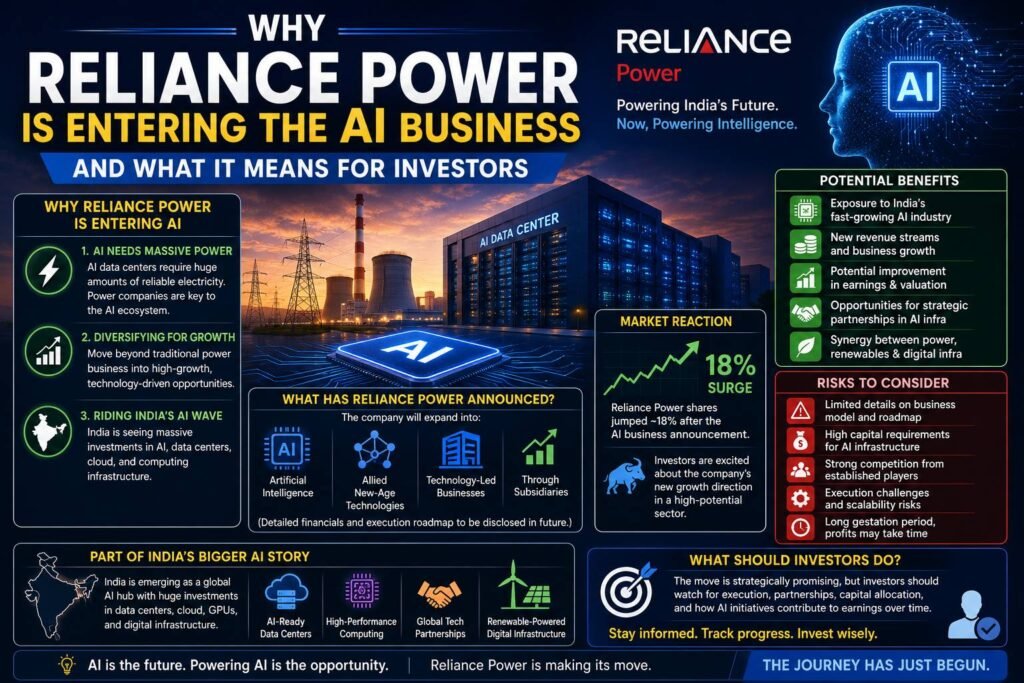

Reliance Power’s Strategic Pivot Toward Artificial Intelligence
India’s energy landscape is undergoing a quiet but significant transformation, and Reliance Power is positioning itself at the center of it. The company, long associated with conventional power generation and infrastructure, has announced its intention to enter the artificial intelligence business — a move that has sparked considerable debate among analysts, institutional investors, and retail shareholders alike. Understanding why Reliance Power is entering the AI business and what it means for investors requires a close look at the strategic logic, the market opportunity, and the risks involved.
The Strategic Rationale Behind the Move
Reliance Power’s decision to diversify into AI is not happening in a vacuum. Across the globe, energy companies are recognizing that the infrastructure powering artificial intelligence — data centers, high-performance computing clusters, and advanced cooling systems — demands enormous amounts of electricity. This creates a natural synergy between power generation companies and the AI industry.
The company appears to be targeting the AI data center segment, where demand for reliable, large-scale power supply is growing exponentially. India’s digital economy is expanding rapidly, and the country is increasingly being viewed as a potential hub for AI infrastructure investment, particularly as global technology companies look to diversify beyond the United States and China.
By leveraging its existing expertise in power generation and its established infrastructure capabilities, Reliance Power is attempting to position itself as an end-to-end solutions provider — one that can not only supply the electricity that AI operations require but also potentially develop or co-develop data center facilities.
The Market Opportunity in India and Beyond
The timing of this strategic shift is deliberate. India’s government has been actively promoting domestic AI development through policy initiatives, and the demand for data center capacity across the subcontinent is projected to grow substantially over the next decade. Global hyperscalers, including major cloud providers, have announced significant investments in Indian infrastructure, and that creates downstream demand for the kind of large-scale, dependable power supply that companies like Reliance Power can theoretically provide.
Beyond domestic demand, there is a broader geopolitical dimension. As nations seek to build sovereign AI capabilities, the infrastructure supporting those capabilities — including power grids and data facilities — becomes strategically important. Reliance Power’s move into this space aligns it with national priorities, which could translate into favorable regulatory treatment and government contracts.
Data Centers as the New Power Consumers
Traditional industrial consumers of electricity — steel mills, cement plants, chemical factories — are being joined by a new category of energy-intensive operations: AI data centers. A single large-scale AI training facility can consume as much electricity as a small city. For a power company looking to secure long-term, high-value customers, this sector represents a compelling opportunity.
Reliance Power’s entry into AI-adjacent infrastructure essentially means creating captive demand for its own power generation assets. This vertical integration model, if executed well, could improve revenue predictability and reduce the company’s exposure to the volatility of merchant power markets.
What This Means for Investors
For investors evaluating this development, the picture is nuanced. On the surface, any company announcing an AI-related strategy tends to attract market attention, and Reliance Power’s stock has reflected that pattern with increased trading activity following the announcement. However, investors should look beyond the headline and assess the substance of the strategy.
Potential Upside
- Diversification of revenue streams: Moving into AI infrastructure reduces Reliance Power’s dependence on traditional power purchase agreements and opens new commercial avenues.
- Alignment with high-growth sectors: AI and data center infrastructure are among the fastest-growing segments globally, and early positioning in this space could yield significant long-term returns.
- Government tailwinds: India’s policy environment is supportive of both domestic AI development and infrastructure investment, which could accelerate project approvals and funding access.
- Valuation re-rating potential: Markets often assign higher valuation multiples to technology-adjacent businesses compared to traditional utilities, meaning a credible AI strategy could improve the company’s price-to-earnings ratio over time.
Key Risks to Consider
- Execution uncertainty: Entering a new, technically complex industry is challenging. Reliance Power will need to build or acquire significant new capabilities in areas like data center design, cooling technology, and AI-specific infrastructure management.
- Capital requirements: Developing AI infrastructure is capital-intensive. Investors should scrutinize how the company plans to finance this expansion, particularly given its historical debt challenges.
- Competition: The data center and AI infrastructure space is attracting well-capitalized players, including global technology giants and specialized real estate investment trusts. Competing against these entities will require differentiated offerings.
- Regulatory and financial history: Reliance Power has faced regulatory scrutiny and financial difficulties in the past. Investors should conduct thorough due diligence on the company’s current balance sheet health and governance standards before making decisions based on the AI narrative alone.
Reading the Announcement Carefully
One of the most important lessons for investors when any traditional company announces an AI pivot is to distinguish between genuine strategic transformation and opportunistic branding. Why Reliance Power is entering the AI business matters less than how it plans to do so and whether it has the financial and operational capacity to follow through.
Investors should look for concrete milestones: signed agreements with technology partners, specific capital allocation plans, regulatory filings, and evidence of technical expertise being brought into the organization. Vague announcements with no operational detail should be treated with appropriate skepticism.
Read more about Ai releated content from Crecso
The Bigger Picture
Reliance Power’s foray into AI infrastructure reflects a broader trend of convergence between the energy sector and the technology industry. As AI continues to reshape the global economy, the physical infrastructure supporting it — power, cooling, connectivity — becomes as strategically valuable as the algorithms themselves.
For long-term investors with a high risk tolerance and confidence in India’s digital growth trajectory, this development is worth monitoring closely. For more conservative investors, waiting for tangible proof of execution before adjusting positions may be the more prudent approach. Either way, understanding why Reliance Power is entering the AI business and what it means for investors is now an essential part of evaluating the company’s future prospects.
READ MORE:
- Beginner’s Guide to Using ChatGPT More Effectively in 2026
- Personal Branding for Students in India: A Complete Guide for 2026
- How to Create a Behance Portfolio That Gets Noticed by Recruiters and Clients
Published By Branding.net.in