
Vidrush AI vs ChatGPT: Which AI Assistant Is Better?
The AI assistant landscape has expanded dramatically over the past few years, giving individuals and businesses more choices than ever before. Among the tools generating significant attention are Vidrush AI and ChatGPT — two platforms that serve overlapping yet distinct purposes. If you’ve been weighing Vidrush AI vs ChatGPT to determine which AI assistant is better for your specific needs, this detailed comparison will help you make an informed decision.
What Is Vidrush AI?
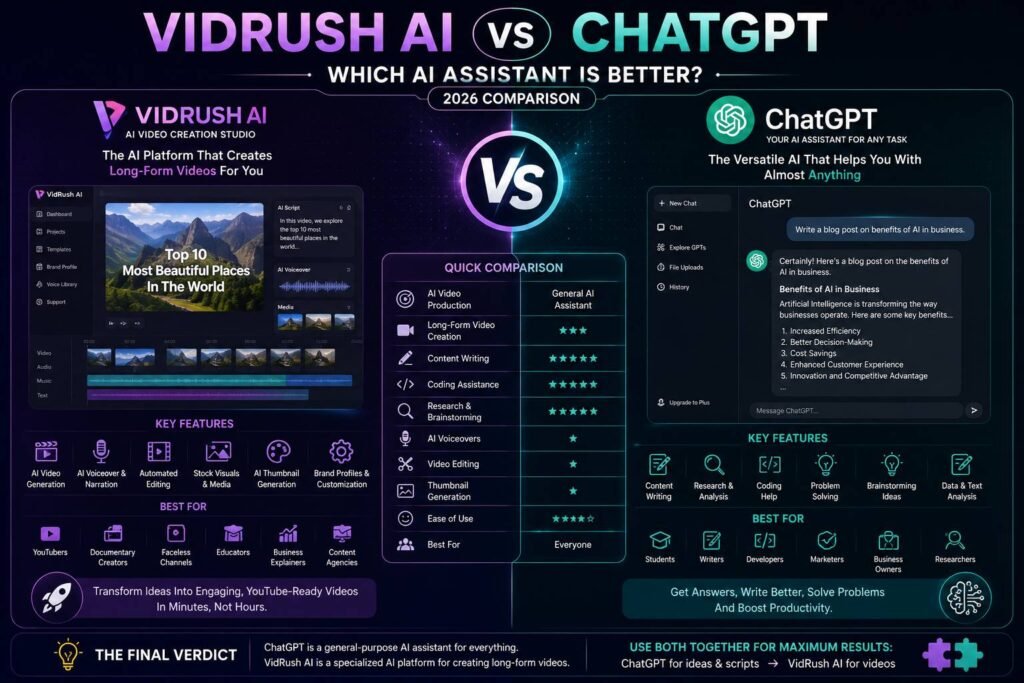
Vidrush AI is a specialized artificial intelligence platform designed primarily around video content creation and optimization. It targets content creators, marketers, and businesses that rely heavily on video as a medium for communication, marketing, and audience engagement. The platform typically offers features such as automated video scripting, AI-generated voiceovers, content repurposing from text to video, and analytics-driven suggestions to improve video performance.
Vidrush AI positions itself as a vertical AI tool — one built with a narrow but deep focus on a specific domain rather than attempting to do everything at once.
What Is ChatGPT?
ChatGPT, developed by OpenAI, is one of the most widely recognized general-purpose AI assistants in the world. Powered by large language models like GPT-4, it can handle an enormous range of tasks including writing, coding, research, brainstorming, translation, summarization, customer support automation, and much more. ChatGPT is conversational by nature, making it highly accessible and adaptable across industries and use cases.
Unlike Vidrush AI, ChatGPT is a horizontal tool — built to serve a broad audience with diverse needs rather than specializing in one area.
Core Feature Comparison
Content Creation Capabilities
When comparing Vidrush AI vs ChatGPT for content creation, the distinction becomes immediately clear. ChatGPT excels at generating long-form written content, marketing copy, blog posts, email campaigns, and social media captions. It can adapt tone, style, and format based on user prompts with remarkable flexibility.
Vidrush AI, on the other hand, focuses its content creation tools on video-specific outputs. This includes generating video scripts optimized for engagement, producing storyboards, and converting existing written content into video-ready formats. For creators who live and breathe video content, this specialization can be a significant advantage.
Ease of Use
ChatGPT is designed for intuitive, conversational interaction. Users simply type a prompt and receive a response — no technical background required. This simplicity has made it enormously popular with beginners and professionals alike.
Vidrush AI tends to have a more structured interface tailored to video workflows. While it may feel more purposeful for video creators, those unfamiliar with video production pipelines might face a steeper learning curve.
Integration and Workflow
ChatGPT integrates with a wide variety of third-party tools through APIs and plugins, making it adaptable to complex workflows across marketing, development, and operations. It can plug into platforms like Zapier, Slack, and various CRM systems.
Vidrush AI is typically built to integrate with video hosting platforms, social media schedulers, and content management systems relevant to video marketing. Its integrations are more targeted but highly relevant within its niche.
Use Case Scenarios
For Video Content Creators
If your primary goal is to produce video content at scale — whether for YouTube, TikTok, Instagram, or corporate training — Vidrush AI offers purpose-built tools that ChatGPT simply wasn’t designed to replicate. Automated scripting, scene suggestions, and video optimization features can dramatically reduce production time.
For Writers, Marketers, and Businesses
For teams that need versatile text-based assistance — drafting proposals, generating marketing strategies, answering customer queries, or supporting software development — ChatGPT is the clear winner. Its breadth of capability makes it a reliable daily driver for a wide range of professional tasks.
For Entrepreneurs and Solopreneurs
Those managing multiple aspects of a business may find ChatGPT more cost-effective and versatile. However, if video marketing is a cornerstone of a business strategy, combining both tools might be the optimal approach rather than choosing one over the other.
Pricing and Accessibility
ChatGPT offers a free tier with access to GPT-3.5, along with a paid subscription (ChatGPT Plus) that unlocks GPT-4 and additional features. This tiered approach makes it accessible to users at virtually every budget level.
Vidrush AI’s pricing structure is typically subscription-based and oriented toward professional creators and teams. It may not have a robust free tier, which could be a barrier for casual users or those just starting out.
Strengths and Limitations
Vidrush AI Strengths
- Deep specialization in video content creation
- Tools designed to streamline video production workflows
- Optimized for content creators and video marketers
Vidrush AI Limitations
- Limited utility outside of video-related tasks
- Potentially higher barrier to entry for non-video professionals
- Smaller user community compared to ChatGPT
ChatGPT Strengths
- Exceptional versatility across dozens of use cases
- Highly accessible and easy to use
- Robust API ecosystem and third-party integrations
- Large, active user community and extensive documentation
ChatGPT Limitations
- Not specialized for video production workflows
- Requires additional tools to handle multimedia tasks
- Output quality depends heavily on prompt quality
Which AI Assistant Is Better?
Ultimately, the question of Vidrush AI vs ChatGPT — which AI assistant is better — doesn’t have a universal answer. It depends entirely on your goals, workflow, and industry.
- Choose Vidrush AI if your work revolves around video content creation, you need specialized tools to speed up video production, and you’re willing to invest in a platform built specifically for that purpose.
- Choose ChatGPT if you need a versatile, all-purpose AI assistant capable of supporting a wide range of tasks, from writing and research to coding and customer communication.
For many professionals, the most powerful approach is to use both tools in tandem — leveraging ChatGPT for broad content and communication needs while relying on Vidrush AI for video-specific workflows. As AI tools continue to evolve, the lines between specialized and general-purpose assistants may blur, but for now, understanding each platform’s core strengths is the key to maximizing productivity.
READ MORE:
- AI Is the New Brand: Why Every Business Is Reinventing Itself in 2026
- Brand Transformation Through AI: Lessons from Reliance Power’s New Strategy
- Why AI Is Becoming a Corporate Branding Strategy for Indian Companies
Published By Branding.net.in